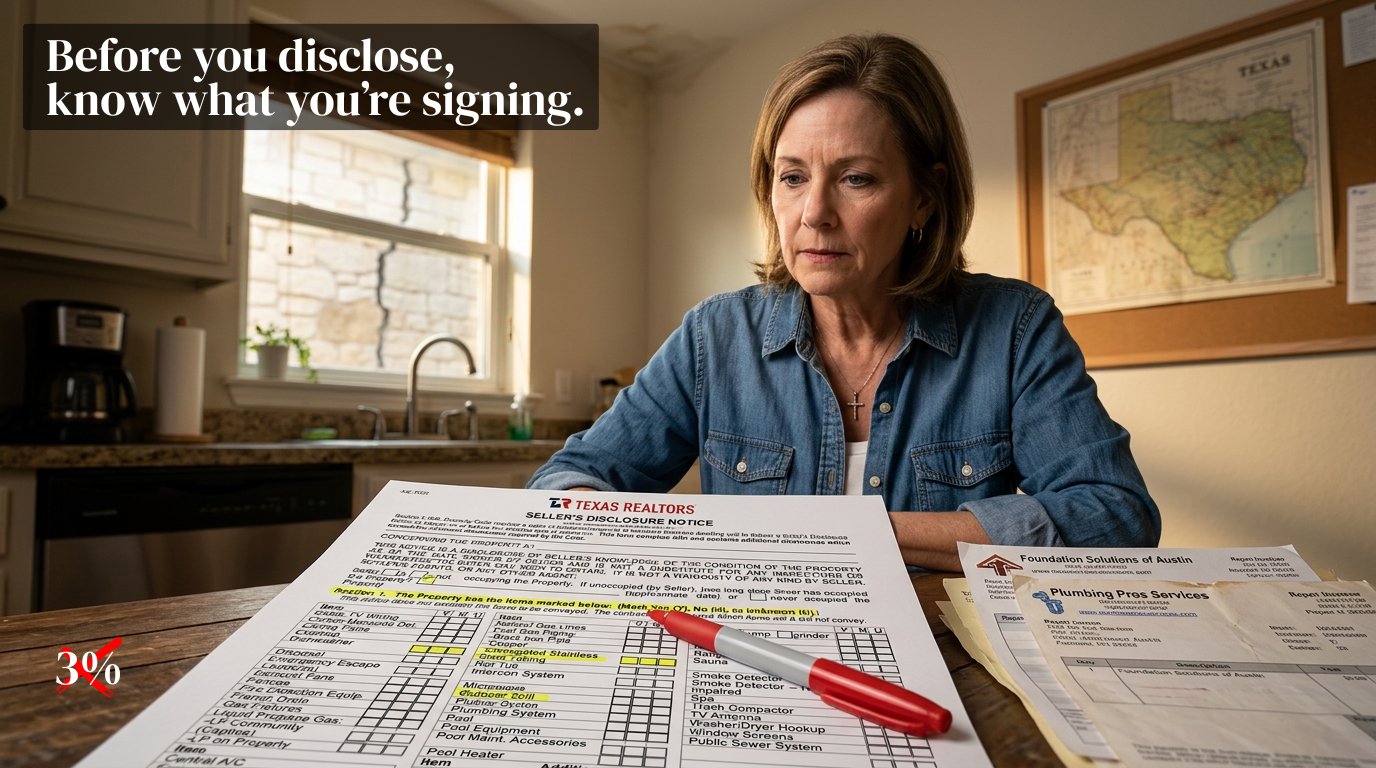
The Seller's Disclosure Notice is the single most important document in a Texas home sale after the contract itself. It is also the document that generates the most lawsuits when completed incorrectly, incompletely, or dishonestly. Approximately 77% of real estate litigation involves disclosure issues, and Texas courts have consistently held sellers accountable for defects they knew about, should have known about, or deliberately failed to report.
This is not a form you rush through. Every answer you give on this document becomes a legal statement about your property. If a buyer discovers a problem after closing that you knew about and did not disclose, you face potential claims under the Texas Deceptive Trade Practices Act with potential damages up to three times the actual loss.
This guide walks through every section of TREC Form 55-1, the current version effective May 2026. It explains what each question is asking, how to answer it, what "unknown" actually means, and the specific mistakes that lead to legal problems. If you read this guide before you sit down with the form, you will complete it accurately and protect yourself.
In this article:
- What the Seller's Disclosure Notice is (and what it is not)
- Two forms, two levels of detail
- Who must file and who is exempt
- Before you start: rules that apply to every question
- Section 1: Property items checklist
- Section 2: Smoke detector compliance
- Section 3: Structural components and known defects
- Section 4: Environmental hazards, property history, and safety conditions
- Section 5: Items in need of repair
- Sections 6 through 8: Flooding, flood insurance, and FEMA assistance
- Section 9: Permits, HOA, lawsuits, and additional conditions
- New in 2026: insurance disclosure and conservation easements
- The five mistakes that cause the most lawsuits
- The as-is myth: why Paragraph 7D does not save you
- After you sign: updating and amending the disclosure
- Frequently asked questions
What the Seller's Disclosure Notice is (and what it is not)
The Seller's Disclosure Notice is required by Texas Property Code Section 5.008. It requires sellers of residential property to provide a written disclosure of known defects and material conditions to the buyer. The language at the top of the TREC form says it clearly: "This notice is a disclosure of seller's knowledge of the condition of the property as of the date signed by seller and is not a substitute for any inspections or warranties the purchaser may wish to obtain. It is not a warranty of any kind by seller or seller's agents."
Three things that statement tells you. First, the disclosure is based on your actual knowledge. You are disclosing what you know, not what an inspector might find. Second, the disclosure is dated. It is a snapshot of your knowledge on the specific date you sign it. If you learn something new after signing, you have an obligation to update it. Third, the disclosure is not a warranty. You are not guaranteeing the condition of anything. You are stating what you know.
Understanding what the disclosure is not is equally important. It is not a home inspection report. It is not a substitute for the buyer hiring their own inspector. It is not an invitation for the buyer to skip their due diligence. And it is not a document your agent or broker fills out for you. This is your form. Your knowledge. Your signature. Your legal responsibility.
Two forms, two levels of detail
There are two versions of the Seller's Disclosure Notice used in Texas, and understanding the difference matters.
TREC Form 55-1 is the statutory minimum. It is published by the Texas Real Estate Commission, is available to anyone for free on the TREC website, and covers exactly what Texas Property Code Section 5.008 requires. It is four pages, organized into eleven sections. This is the form most FSBO sellers and flat-fee MLS services use.
TXR-1406 is the Texas REALTORS version. It is more detailed than the TREC form, includes additional questions beyond the statutory minimum, and is typically used by licensed listing agents who are members of Texas REALTORS. This form requires a REALTORS membership to access and is not publicly available.
Both forms satisfy the legal requirement. The TREC form is perfectly valid. If you are selling through Waymark, you will use the TREC form, and Aria walks you through every question to ensure nothing is missed. If a buyer's agent asks for the TXR version, the TREC form is a legally sufficient alternative. You are not required to use the TXR form.
Who must file and who is exempt
Most residential property sales in Texas require a Seller's Disclosure Notice. The law applies to the sale of previously occupied single-family residences. If you are selling a home that someone has lived in, you almost certainly need to complete this form.
Exemptions under Texas Property Code Section 5.008(e) include:
Sales pursuant to a court order or foreclosure. Transfers by a fiduciary in the course of administration of a decedent's estate, guardianship, conservatorship, or trust. Transfers from one co-owner to another co-owner. Transfers to a spouse or a person in the lineal line of consanguinity (parent, child, grandparent, grandchild). Sales of new construction that has never been occupied. Transfers by a government entity. Sales where the buyer is a mortgage lender who is acquiring the property through foreclosure or a deed in lieu of foreclosure.
A common misconception is that landlords who never lived in the property do not need to file. That is incorrect in most cases. If you own the property and have knowledge of its condition, the disclosure obligation applies regardless of whether you personally occupied the home. An absentee owner who managed a rental property for ten years has knowledge of that property's condition and is expected to disclose it.
Before you start: rules that apply to every question
Before you answer a single question on the form, internalize these principles. They will prevent the majority of disclosure-related legal problems.
Answer every question. The form uses a Y (Yes), N (No), U (Unknown) format. Every question must receive one of these three answers. A blank space is not the same as "Unknown." A blank space is an incomplete disclosure. An incomplete disclosure gives the buyer grounds to challenge the entire document.
"Unknown" is a valid answer when it is genuine. If you truly do not know whether the home has aluminum wiring, "Unknown" is the correct answer. But "Unknown" is not a strategic tool to avoid disclosing problems you know about. Texas courts have ruled that sellers cannot claim ignorance of defects that a reasonable homeowner would have noticed. If water pools in your backyard every time it rains and you write "Unknown" next to drainage problems, a court will not find that credible.
Disclose repairs, not just current problems. A foundation that was repaired in 2019 and is currently stable still needs to be disclosed. The fact that a problem existed, was identified, and was repaired is material information. Buyers and their inspectors will likely discover evidence of the repair anyway. Disclosing it upfront demonstrates honesty and prevents the buyer from concluding you were hiding something.
Do not let anyone else fill out this form for you. Your agent, your broker, your spouse (unless they are also on the title), and your neighbor who "knows a lot about houses" should not be writing your answers. If an agent tells you what to write, those answers stop being your disclosures and become theirs. They have nothing to disclose about your property. Only you know what you know. Complete the form yourself based on your own knowledge.
When in doubt, disclose. If you are debating whether something is worth mentioning, mention it. A minor disclosure that turns out to be irrelevant costs you nothing. A missing disclosure that turns out to be material can cost you tens of thousands of dollars in legal liability. The standard is simple: if it could affect a buyer's decision, disclose it.
Section 1: Property items checklist
The first section of the form is a long checklist of property items. For each item, you write Y (the property has it), N (it does not), or U (you do not know). The list covers appliances and systems including range, oven, microwave, dishwasher, trash compactor, disposal, washer/dryer hookups. Safety items including security system, fire detection equipment, smoke detectors, carbon monoxide alarms, and emergency escape ladders. Climate systems including central AC, central heating, wall/window AC, attic fans, exhaust fans, and ceiling fans. Infrastructure including plumbing, septic system, public sewer, natural gas lines, gas fixtures, and LP gas. Outdoor features including patio/decking, outdoor grill, fences, pool, sauna, spa, hot tub, pool equipment, pool heater, and automatic lawn sprinkler system. Garage details including attached versus detached, carport, garage door openers. Water heater type (gas or electric) and water supply source (city, well, MUD, co-op). Roof type and approximate age.
After the checklist, the form asks the critical follow-up question: "Are you (Seller) aware of any of the above items that are not in working condition, that have known defects, or that are in need of repair?" If your answer is Yes, you must describe the issues.
How to approach this section: Walk through the checklist room by room. Start in the kitchen (range, oven, microwave, dishwasher, disposal). Move to the laundry (washer/dryer hookups). Check the garage (door openers, attached or not). Walk the exterior (fences, sprinklers, pool). Check the mechanical room or closet (water heater type, HVAC). Go to the roof (type and approximate age). For the follow-up question about working condition, be specific. "Pool heater is not functioning" is better than "pool issues." "Garage door opener intermittently fails to respond to remote" is better than "garage door has problems."
The roof age question deserves special attention. If your roof is 15 years old or older, the buyer's insurer may require a roof inspection before issuing a homeowner's policy. Disclosing the approximate age upfront prevents a surprise during the insurance underwriting process that could delay closing. If you replaced the roof, include the year and whether there is a transferable warranty.
Section 2: Smoke detector compliance
This section asks whether the property has working smoke detectors installed in accordance with Chapter 766 of the Health and Safety Code. The law requires smoke detectors in all sleeping areas and in the hallways leading to sleeping areas. If you are not sure whether your smoke detectors meet the current building code requirements for your area, "Unknown" is an acceptable answer, and the form specifically suggests contacting your local building official.
This section also includes a provision for hearing-impaired smoke detectors. If the buyer or a member of the buyer's family is hearing impaired and provides written evidence from a licensed physician within 10 days of the effective date, they can request that you install hearing-impaired smoke detectors and specify the locations. The cost responsibility is negotiated between buyer and seller.
Practical note: Replace the batteries in all smoke detectors before listing. Test every unit. If any detector is more than 10 years old, replace it. This is a $15 to $30 fix per detector that prevents a disclosure issue and demonstrates that the home meets safety requirements.
Section 3: Structural components and known defects
This is the section that matters most to buyers and carries the most legal significance. The form asks whether you are aware of any known defects or malfunctions in the following components: interior walls, ceilings, floors, exterior walls, doors, windows, roof, foundation/slabs, sidewalks, walls/fences, driveways, intercom system, plumbing/sewers/septics, electrical systems, lighting fixtures, and other structural components.
For each item, you write Y (you are aware of a defect) or N (you are not). If any answer is Y, you must explain the issue.
Foundation: This is the most scrutinized item in the entire disclosure, especially in Texas where expansive clay soil causes more foundation movement than in most states. Disclose any known cracks, previous repairs, pier installations, leveling work, drainage systems installed to address foundation issues, and whether you have ever had a structural engineering report. If the answer to any of those is yes, the buyer's inspector will find evidence of the work. Disclosing it first is always better than having the inspector discover it. If you had foundation work done, include who did the work, when it was done, what was done, and whether there is a transferable warranty.
Roof: Disclose any leaks (past or present), repairs, partial or full replacements, hail damage, wind damage, and insurance claims related to the roof. Even if a leak was repaired and has not recurred, the repair itself is a material fact. Include dates whenever possible.
Plumbing: Disclose the pipe material if you know it. This is especially important if the home has polybutylene piping (common in Texas homes built between 1978 and 1995) or galvanized steel pipes, both of which are known to have higher failure rates. Disclose any leaks, water damage from plumbing failures, sewer line issues, or water heater problems.
Electrical: The form specifically asks about aluminum wiring in Section 4, but any known electrical issues should be disclosed here as well. If you have experienced repeated breaker trips, flickering lights, or outlets that do not work, note them.
HVAC: Disclose the age and condition of the system. If your AC unit is 18 years old and still running, say so. "Working" and "reliable" are not the same thing. The buyer's inspector will note the age regardless, and an honest disclosure about an aging system builds credibility rather than creating suspicion.
Section 4: Environmental hazards, property history, and safety conditions
This section asks about a wide range of conditions that go beyond the physical structure. For each item, you write Y (you are aware) or N (you are not aware). The items include:
Pest and wood damage: Active termites (including all wood-destroying insects), termite or wood rot damage needing repair, previous termite damage, and previous termite treatment. If you have ever had a termite treatment, disclose it even if no active termites were found. The treatment history is a material fact.
Water and soil: Improper drainage, water damage not due to a flood event (this covers plumbing leaks, roof leaks, and other non-flood water intrusion), landfill, settling, soil movement, and fault lines.
Safety hazards: Single blockable main drain in pool/hot tub/spa (which creates a suction entrapment hazard), hazardous or toxic waste, asbestos components, urea-formaldehyde insulation, radon gas, lead-based paint (homes built before 1978 have additional federal disclosure requirements), and aluminum wiring.
Property history: Previous structural or roof repair, previous fires, unplatted easements, subsurface structures or pits, and previous use of the premises for manufacture of methamphetamine.
If any answer is Y, you must explain the details. Be specific and factual. "Previous termite treatment by ABC Pest Control, March 2021, no active termites found" is a complete answer. "Some termite stuff happened" is not.
Section 5: Items in need of repair
This is a catch-all question: "Are you aware of any item, equipment, or system in or on the property that is in need of repair?" This captures anything that does not fit neatly into the preceding sections. A broken fence post, a garage door that sticks, a dishwasher that leaks intermittently, a window that does not lock properly. If you know about it and it needs repair, disclose it here.
This section works in your favor when completed thoroughly. Every item you disclose here is an item the buyer's inspector cannot "discover" as a surprise. Surprises during the option period create leverage for the buyer to request repairs or credits. Items you already disclosed are expected, not discovered.
Sections 6 through 8: Flooding, flood insurance, and FEMA assistance
These three sections were significantly expanded after Hurricane Harvey in 2019 and are among the most heavily scrutinized parts of the disclosure in Houston, Beaumont, and coastal Texas markets.
Section 6 asks whether you are aware of any of the following flood-related conditions: present flood insurance coverage, previous flooding due to a failure or breach of a reservoir or controlled/emergency release of water, and previous water penetration into a structure on the property due to a natural flood event. It also asks whether the property is located wholly or partly in a 100-year floodplain (Special Flood Hazard Area), a 500-year floodplain, a floodway, a flood pool, or a reservoir.
The form includes detailed statutory definitions of each flood zone category. You do not need to memorize them. What matters is whether you know your property's flood zone designation. This information is available on FEMA's Flood Map Service Center by searching your address. If your property is in a high-risk flood zone and has a federally backed mortgage, you are required to carry flood insurance, so you likely already know your zone.
Section 7 asks whether you have ever filed a claim for flood damage with any insurance provider, including the National Flood Insurance Program. If yes, you must explain.
Section 8 asks whether you have ever received assistance from FEMA or the U.S. Small Business Administration for flood damage. If yes, you must explain.
These flood sections are not optional or minor. In markets affected by Harvey, Imelda, or other major flood events, the flood disclosure is often the most closely reviewed portion of the entire form. If your property flooded and you received FEMA assistance or filed an insurance claim, those facts are verifiable through public records. Failing to disclose them is one of the fastest paths to a post-closing lawsuit.
Section 9: Permits, HOA, lawsuits, and additional conditions
This section asks about conditions that go beyond the physical property into legal, regulatory, and community territory. For each item, write Y or N.
Unpermitted work: Room additions, structural modifications, or other alterations or repairs made without necessary permits or not in compliance with building codes in effect at the time. If you converted a garage to a bedroom without a permit, enclosed a patio, or added a bathroom, disclose it. Unpermitted work can affect the buyer's ability to insure the property, obtain financing, or resell in the future.
HOA information: Homeowners association or maintenance fees and assessments, and any common areas co-owned in undivided interest with others. If your property is in an HOA, the buyer needs to know the fee amount, the frequency, and what it covers. A separate HOA resale certificate is also required and includes the governing documents.
Legal conditions: Any notices of violations of deed restrictions or governmental ordinances, any lawsuits directly or indirectly affecting the property, and any condition that materially affects the physical health or safety of an individual. If you received a city code violation for an overgrown lot, a deed restriction violation from your HOA for an unapproved fence color, or a notice from the health department, disclose it.
Water and environmental: Any rainwater harvesting system larger than 500 gallons that uses public water as an auxiliary source, and any portion of the property located in a groundwater conservation district or subsidence district.
Military installation: Section 11 of the form notes that the property may be located near a military installation and may be affected by high noise or air installation compatible use zones. This is an informational notice, not a disclosure question, but sellers in areas near bases like Joint Base San Antonio, Fort Cavazos (formerly Fort Hood), or Naval Air Station Corpus Christi should be aware of it.
Storage tanks: Any above-ground or underground storage tanks on the property, including above-ground tanks holding 500 gallons or more that have stored petroleum products or other chemicals. If an underground storage tank exists, additional disclosure requirements under 30 Texas Administrative Code Chapter 334 apply.
New in 2026: insurance disclosure and conservation easements
TREC Form 55-1, effective May 2026, replaced the previous Form 55-0 and added several new disclosure items. These changes were directed by the Sunset Advisory Commission during TREC's periodic review and address gaps in what sellers were previously required to disclose.
Insurance coverage: Three new questions ask whether the property is presently covered by insurance, whether it is covered by windstorm insurance, and whether the seller has been unable to insure the property for any reason. This is the most significant change in the 2026 update. In recent years, several major insurance carriers have reduced coverage or exited the Texas market entirely, particularly for homes with older roofs, previous claims, or locations in hail-prone areas. A property that cannot be insured, or can only be insured through the Texas FAIR Plan at elevated rates, presents a significant financial risk to buyers. These new questions give buyers critical information they would otherwise discover only after committing to the purchase.
Conservation easements: A new question asks whether any conservation easements are located on the property. The form defines a conservation easement as an easement (permanent or for a period of years) that restricts the use of all or part of the property to protect natural resources, wildlife habitat, open space, or historical sites. Conservation easements can significantly limit what a buyer can do with the land, and disclosing them upfront prevents disputes after closing.
Water rights disclosure (new separate form): TREC also created a new standalone form, TREC Form 61-0, the Seller's Disclosure about Groundwater and Surface Water Rights, effective July 2026. This form requires sellers to disclose what they know about groundwater and surface water rights on the property, including whether the property is in a Groundwater Conservation District and whether there are water wells. This is a separate form from the Seller's Disclosure Notice and applies primarily to rural and semi-rural properties.
The five mistakes that cause the most lawsuits
Mistake 1: Leaving sections blank
A blank section is not an answer. It is an incomplete disclosure. If you leave a section blank, the buyer can argue that you deliberately avoided the question. Every item on the form must be answered Y, N, or U. There are no exceptions. If you genuinely do not know the answer, write U. If you know the answer, write Y or N. Never leave a blank.
Mistake 2: Using "unknown" as a strategy
"Unknown" is a valid answer when it reflects genuine ignorance. It is not a legal shield against problems you know about. Texas courts apply a "reasonable homeowner" standard. If you have lived in the home for 15 years and water enters the garage every time it rains, marking "Unknown" next to drainage problems will not protect you. The court will conclude that a reasonable person living in the home for 15 years would be aware of recurring water intrusion.
Mistake 3: Disclosing current problems but not past repairs
Many sellers disclose a foundation that is currently cracking but fail to mention the foundation repair they did five years ago. Both are material facts. The repair history tells the buyer that the foundation has moved before and may move again. The repair company, the date, the scope of work, and the warranty terms are all relevant. Omitting the repair history while disclosing the current condition creates an incomplete picture that the buyer's inspector will likely uncover anyway.
Mistake 4: Relying on as-is to avoid disclosure
"As-is" and "disclosure" are two completely separate legal concepts. See the next section for a full explanation.
Mistake 5: Failing to update the disclosure
The disclosure is dated. It reflects your knowledge on the date you signed it. If you discover a new problem after signing the disclosure but before closing, you have an obligation to update it. If the AC fails in July and you signed the disclosure in May, you need to provide an updated disclosure noting the AC failure. Selling a home with a known broken system that was not disclosed because it broke after you signed the form is not a defense. The buyer is entitled to a current picture of the property's condition.
The as-is myth: why Paragraph 7D does not save you
This is the most dangerous misconception in Texas real estate. Many sellers believe that because the buyer checked "as-is" under Paragraph 7D of the TREC contract, they do not need to worry about the disclosure. That is wrong.
The as-is provision in Paragraph 7D is a contract term about repairs. It means the buyer is accepting the property in its current condition with any and all defects. It does not mean the buyer is waiving their right to know what those defects are. The Seller's Disclosure Notice is a statutory requirement under Texas Property Code Section 5.008. It exists independently of the contract. No contract provision can waive a statutory disclosure obligation.
Here is the distinction: "as-is" means the buyer accepts the condition. The disclosure tells the buyer what that condition is. A buyer who checks "as-is" is saying "I will buy the home without requiring repairs." They are not saying "I do not want to know about problems." If you know the foundation is cracked and you fail to disclose it because the contract says "as-is," you are liable for the non-disclosure regardless of the as-is clause.
After you sign: updating and amending the disclosure
The disclosure is a living document until closing. If anything changes between the date you sign the form and the closing date, you must update the disclosure in writing and deliver the updated version to the buyer.
Common situations that trigger an update: the AC stops working, a pipe bursts, a new crack appears in the foundation, you discover termite damage while moving furniture, you receive an HOA violation notice, or you learn that the property is being rezoned. Any new information that would have changed your original answers requires an amendment.
The update does not need to be on a new form. A written amendment referencing the original disclosure date, identifying the specific section and question being updated, and providing the new information is sufficient. Deliver it to the buyer and retain a copy for your records.
Frequently asked questions
How long before listing should I complete the disclosure?
Complete it before your home goes live on the MLS. Having the disclosure ready before offers arrive means buyers can review it before submitting an offer, which reduces the likelihood of surprises during the option period. Many experienced buyer's agents request the disclosure before their client writes an offer. Having it ready signals professionalism and transparency.
Can I complete the disclosure myself without an agent?
Yes. The TREC form is publicly available and can be completed by any property owner. However, the form was designed for use by professionals familiar with real estate terminology. If you are unsure about any question, consult your broker. On Waymark, Aria walks you through every question on the disclosure, explains what each question is asking in plain language, and flags any answers that may need clarification before your broker reviews the form.
What if I inherited the property and never lived in it?
You still need to complete the disclosure based on what you know. If you inherited a home and have never lived in it, you may genuinely not know the answers to many questions. "Unknown" is the correct answer for items you have no knowledge of. However, if the estate provided you with any information about the property's condition, maintenance records, or repair history, you are expected to disclose that information. An executor who received a termite treatment invoice from the estate files and marks "Unknown" next to termite treatment is not providing a genuine unknown.
What is the deadline for delivering the disclosure to the buyer?
The TREC contract specifies the delivery deadline, typically within the timeframe set in Paragraph 7. If the disclosure is not delivered on time, the buyer has the right to terminate the contract and receive a full refund of their earnest money. Deliver the disclosure as early as possible to avoid this risk.
Can the buyer terminate based on what the disclosure reveals?
The disclosure itself does not give the buyer a contractual right to terminate. However, if the buyer purchased an option period, they can terminate for any reason during that window, including information they learned from the disclosure. The disclosure often informs the buyer's inspection strategy. If you disclosed a previous foundation repair, the buyer will likely hire a structural engineer during the option period.
How does Waymark help with the Seller's Disclosure?
Waymark's AI, Aria, guides you through every question on the TREC Seller's Disclosure Notice in plain language. For each question, Aria explains what is being asked, why it matters, and what a complete answer looks like. Aria flags answers that may need clarification or additional detail, identifies sections that are commonly left incomplete, and ensures the form is fully complete before your broker reviews it. On the Manage plan, your licensed broker reviews the completed disclosure for accuracy and compliance before it is delivered to the buyer. This two-layer review process, AI guidance followed by human broker review, ensures that your disclosure protects you rather than exposing you.
Selling your Texas home? An agent costs you 3%. FSBO costs you protection. Waymark gives you both for $699. Start your listing at waymarkre.com.