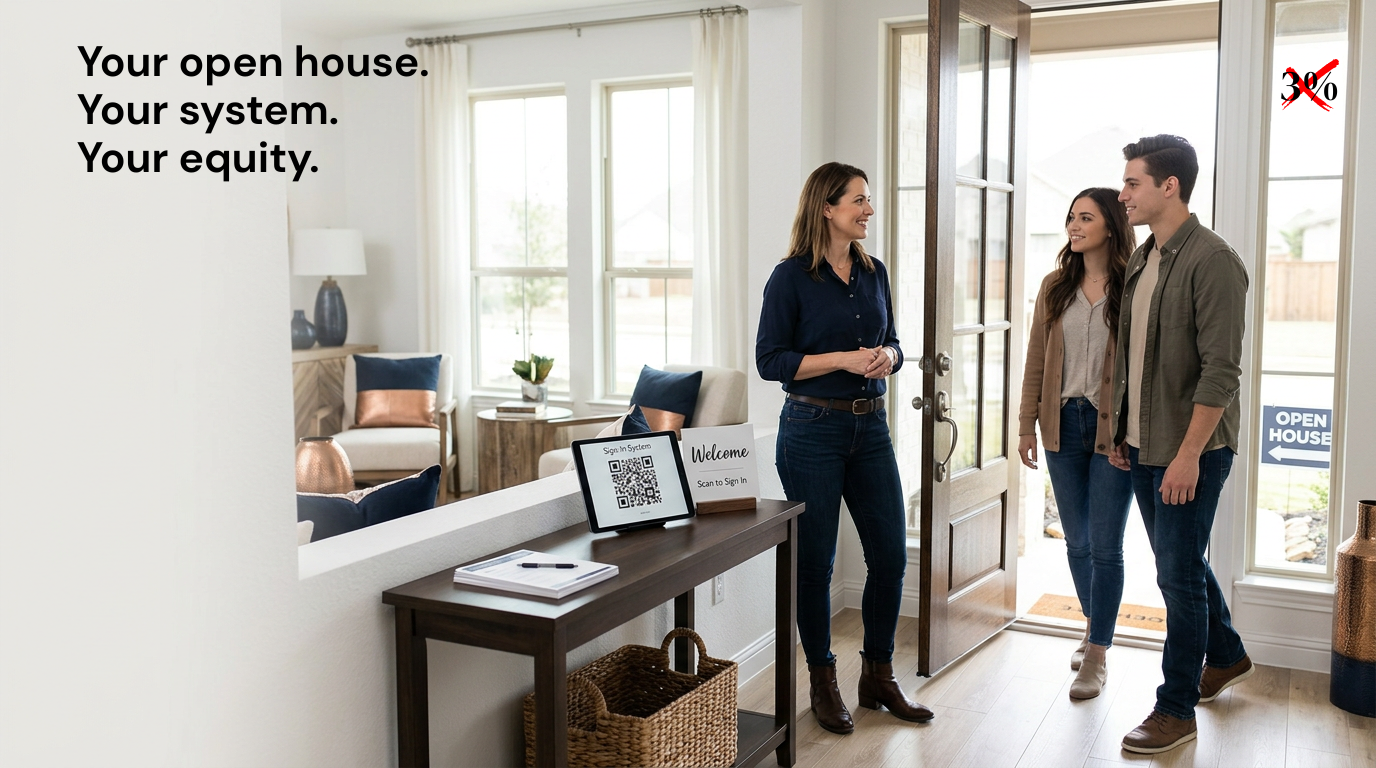
An open house is one of the most effective ways to generate buyer interest, especially in the first two weeks your home is on the market. In 2025, 58% of agents used open houses to market properties and 49% of buyers found their homes through open house visits, according to NAR research. The format is far from dead. It has just changed.
The difference when you sell with Waymark is that you host the open house yourself instead of handing it to a listing agent. That sounds intimidating if you have never done it, but the mechanics are simple once you understand the preparation, the flow, and the follow-up. This guide walks you through every step, from scheduling to the last visitor walking out the door.
In this article:
- How open houses work without a listing agent
- When to schedule your open house
- One week before: preparation checklist
- The day before: final prep
- The sign-in system: paper, digital, or both
- During the open house: what to do and say
- What to never say at an open house
- Safety for solo sellers
- After the open house: follow-up that works
- Advanced strategies that top sellers use
- Waymark open house pricing
- Frequently asked questions
How open houses work without a listing agent
When your home is listed on the MLS through Waymark, your broker handles the MLS side of the open house. You decide the date and time, notify your broker at least three days in advance, and the broker adds the open house to the MLS. From there, it syndicates automatically to Zillow, Realtor.com, Redfin, Homes.com, and every other major listing site that pulls from your MLS board.
Buyers searching for open houses in your area will see yours listed alongside agent-hosted open houses. There is no visual difference on the listing sites. The listing shows the date, time, and that the event is hosted by the seller. Buyer's agents also see it in their MLS searches and may bring their clients directly.
You handle the event itself: preparing the home, greeting visitors, providing information, collecting contact details, and following up afterward. Everything a listing agent would do at an open house, you do. The difference is you do not pay 3% for the privilege.
When to schedule your open house
Timing matters more than most sellers realize. The wrong time slot can cut your traffic in half.
Best days: Saturday and Sunday. Sunday typically draws more traffic in Texas markets because buyer's agents schedule weekend showings on Sundays and buyers who are casually browsing tend to explore on Sunday afternoons. If you can only do one day, choose Sunday.
Best time window: 1:00 PM to 4:00 PM is the standard. This avoids the morning rush, gives people time to get lunch before arriving, and catches the afternoon browsing window. If your area has heavy open house traffic (common in Austin, parts of Houston, and newer suburban developments in San Antonio), consider extending to 12:00 PM to 4:00 PM to capture early browsers.
Best timing in your listing cycle: Host your first open house within the first weekend after your listing goes live on the MLS. The first week of a listing generates the most online views, the most saves, and the most showing requests. Your open house should ride that wave of initial attention. A second open house two weeks later captures buyers who were not looking during the first week.
Avoid: Holiday weekends, major sporting events (especially during football season in Texas), and any weekend where extreme weather is forecast. Check the local open house schedule in your area. If most homes in your neighborhood are open on Sunday, you want to be open on Sunday too so buyers can visit multiple homes in one trip.
One week before: preparation checklist
A successful open house is won in the preparation, not during the event. Start at least a week before.
Notify your broker
Contact your Waymark broker at least three days before the open house (a week is better) so they can add it to the MLS. The MLS entry needs to be live at least two to three days before the event for the syndication to reach all listing sites and for buyer's agents to see it in their searches.
Deep clean the entire home
This is not a regular cleaning day. This is the cleaning you do when your most judgmental relative is visiting. Every surface, every corner, every closet. Buyers open closets. They look under sinks. They check the garage. Anything they can see, they will see.
If you can budget for it, hire a professional cleaning service for a one-time deep clean. In most Texas markets, a deep clean for a 3-bedroom home runs $200 to $400. It is one of the highest-return investments you can make before an open house.
Declutter aggressively
Remove personal photos, religious items, political materials, collections, excess furniture, and anything that makes the home feel like your home instead of their future home. The goal is to create a neutral space where buyers can project themselves into it. Pack at least 30% of your belongings into storage (see our full guide on preparing your home for the MLS), a friend's garage, or a portable storage unit.
Pay special attention to kitchen counters (clear everything except one or two decorative items), bathroom vanities (remove all personal products), bedroom nightstands (clear them completely), and the entryway (remove shoes, coats, and clutter from the first thing buyers see).
Handle deferred maintenance
Fix the things you have been putting off. Touch up scuffed paint. Replace burned-out light bulbs (all of them, including closets and the garage). Fix leaky faucets. Tighten loose cabinet handles. Clean or replace HVAC filters. These small repairs cost almost nothing but their absence signals neglect to buyers.
Boost curb appeal
The buyer forms an impression before they walk through the door. Mow the lawn, edge the walkway, pressure wash the driveway and front porch, clean the front door, replace the doormat, and add a potted plant or two flanking the entry. In Texas, fresh lantana or red salvia in a ceramic pot makes an immediate impression for under $20.
Prepare listing materials
Print 20 to 30 copies of a single-page listing sheet. Include the address, price, bed/bath count, square footage, year built, lot size, key features (renovated kitchen, new roof, pool, etc.), HOA information if applicable, and the Waymark website URL. Do not include your personal phone number on the printed sheet. Direct all inquiries through the listing or through Aria's QR code.
Set up your sign-in system
Prepare both a paper sign-in sheet and a digital QR code (detailed in the sign-in section below). Test the QR code before the event to make sure it works on different phones.
Plan your directional signs
Order or print directional open house signs to place at major intersections near your neighborhood. In most Texas cities, you can place directional signs on the day of the open house and must remove them the same day. Check your HOA rules and local city ordinances. Many communities restrict sign placement to right-of-way areas and require removal by sundown.
The day before: final prep
The day before the open house, do a final walk-through as if you are seeing the home for the first time. Enter through the front door and look at every room with fresh eyes.
Lighting: Open every blind and curtain. Turn on every light in the house, including closets, bathrooms, and the garage. Natural light makes rooms feel larger. Artificial light fills the shadows. A dark room feels smaller and less inviting.
Temperature: Set the thermostat to 72 to 74 degrees. In Texas heat, a cool home is a welcoming home. If your AC struggles to keep up, set it two degrees lower the night before so it is already cool when doors start opening and closing.
Smell: Eliminate odors rather than masking them. No heavy candles, no plug-in air fresheners, no baking cookies (buyers know the trick). If you have pets, have them groomed in the days before, wash all pet bedding, and vacuum thoroughly. A clean, neutral-smelling home is the goal.
Remove valuables: Lock up jewelry, cash, prescription medications, firearms, and important documents. Open houses bring strangers into your home. While most visitors are genuine buyers, it takes only one person to pocket something from a nightstand or medicine cabinet. Remove the temptation entirely.
Remove pets: Take pets to a friend's home, a pet daycare, or a kennel for the duration of the open house. Even friendly pets create complications: some buyers have allergies, some are afraid of dogs, and pet odors or fur on furniture can turn off buyers who are otherwise interested.
The sign-in system: paper, digital, or both
Your sign-in system is the most important operational tool at the open house. Without it, even a busy event leaves you with no way to follow up. Here is how to set it up to capture real, usable contact information.
Use both paper and digital
A digital sign-in via QR code is better in every measurable way: no illegible handwriting, validated email and phone fields, automatic CRM integration, and instant follow-up capability. But some visitors, particularly older buyers or those who are less tech-savvy, prefer paper. Having both options means you never miss a lead.
Setting up the digital sign-in
Create a simple form using a free tool like Curb Hero (used by over 100,000 agents, free for basic use), a Google Form, or any form builder that generates a shareable link. Keep the form short. Ask for name, phone number, email address, and one qualifying question like "Are you currently working with a buyer's agent?" Generate a QR code that links to the form (free at any QR code generator site) and print it on a small sign for the entry table.
On Waymark, visitors who scan your QR code can be routed through Aria for automated follow-up. Aria sends a thank-you message, provides the listing link, and asks if the visitor has questions. This means your follow-up starts while the buyer is still in the car driving away from your home.
Setting up the paper backup
Print a clean, high-contrast sign-in sheet with clear columns: Name, Phone, Email, Working with an Agent (Yes/No). Use large fields so handwriting is legible. Place it on a clipboard at the entrance with a good pen (not a pencil, not a cheap ballpoint that skips).
Getting visitors to actually sign in
This is the part most sellers struggle with. Visitors walk right past the sign-in sheet because they do not want to be contacted. Here is how to increase compliance without being pushy.
Place the sign-in station directly inside the front door where visitors cannot walk past it without seeing it. Stand near it as you greet each person. Say: "Welcome, come on in. If you could just sign in or scan the QR code, that would be great. I have listing sheets on the counter." Keep it casual and brief. Do not explain why they should sign in. Do not apologize for asking. Treat it as the normal first step, because it is.
If someone declines, let them. Do not push. Not every visitor is a buyer. Some are neighbors. Some are curious. The ones who are serious will sign in because they want you to contact them.
During the open house: what to do and say
The open house itself should feel relaxed and welcoming, not like a sales presentation. Your job is to be present, available, and knowledgeable without hovering.
Greet every visitor at the door
Introduce yourself by first name only. "Hi, I am Sarah, welcome. Listing sheets are on the kitchen counter, and feel free to look around. I will be here if you have any questions." That is the entire script. Short, warm, and then you step back.
Let visitors explore on their own
Do not follow them from room to room. Do not narrate the features as they walk through. Buyers want to explore at their own pace, talk privately with their partner, and form their own impressions. If you hover, they rush through and leave. If you step back, they linger, they talk, they start to picture themselves living there.
Position yourself in a central area, ideally the kitchen or living room, where visitors can easily find you when they have questions. Be available, not intrusive.
Answer questions honestly but briefly
When visitors ask about the home, answer their specific question and then stop talking. "How old is the roof?" Answer: "It was replaced in 2022." Do not volunteer additional information about other systems, maintenance history, or what you paid for the roof. Answer the question, smile, and let them continue exploring.
Know your property facts
Have these numbers ready because buyers will ask: square footage, lot size, year built, property tax amount, HOA fee and what it covers, utility costs (average monthly electric and water), school district and zoned schools, age of roof, HVAC, and water heater, and any recent renovations with approximate dates. Write them on a small card and keep it in your pocket if you are worried about forgetting.
What to never say at an open house
This section exists because a single sentence at an open house can cost you thousands of dollars in negotiation leverage. Memorize these rules.
Never discuss your motivation for selling. "We are relocating for work," "we already bought our next home," or "we need to sell by August" all tell the buyer you are under time pressure. Time pressure means the buyer can offer less and wait for you to accept.
Never discuss price flexibility. "We are open to offers" or "the price is negotiable" signals that you expect to sell below list price. If someone asks about the price, respond: "We priced it based on recent comparable sales in the area. I would love to see any offer you would like to submit."
Never discuss how long the home has been on the market. This information is publicly available on the MLS, but volunteering it signals anxiety. If asked, redirect: "It has only been on for a short time and we have had good interest."
Never discuss other offers. Do not say "we have three offers" (it sounds like a pressure tactic even if true) and do not say "we have not received any offers yet" (it signals weakness). If asked, say: "All offers will be reviewed when they come in. I would love to hear yours."
Never discuss the neighbors or the neighborhood negatively. Even if asked directly about noise, parking, or neighbor issues, do not provide negative opinions. Redirect to factual positives: "The neighborhood is really quiet, and we have loved living here."
Never discuss what you would accept. "We would take $300,000" or "we could probably come down $10,000" is giving away money before the negotiation starts. Your list price is your position. Everything else happens through formal offers and counteroffers, in writing, through the contract process.
Safety for solo sellers
Hosting an open house means inviting strangers into your home. Most visitors are genuine, but safety precautions are essential, especially if you are hosting alone.
Never host alone. Have a friend, family member, or neighbor present during the entire open house. Two people means one can stay near the door while the other circulates. If one of you is engaged in conversation with a visitor, the other is watching the rest of the home.
Keep your phone charged and on your person. Do not leave it on the counter. If anything feels wrong, you need your phone immediately.
Lock one room as a secure zone. Choose a bedroom or office, lock the door, and keep your valuables, laptop, important documents, and medications inside. Visitors should not be entering locked rooms.
Leave interior doors open. Every door in the home should be open during the open house. Closed doors create privacy for the wrong kind of activity. Closet doors, cabinet doors, pantry doors: all open. This also makes the home feel more spacious.
Collect identification or at minimum a name. Your sign-in sheet serves a security purpose in addition to a marketing purpose. A visitor who refuses to provide any identification or name is a visitor worth watching more closely.
Know your exits. Walk through the house before the open house and make sure you are aware of all exit paths. If you feel uncomfortable with a visitor's behavior at any point, you can end the open house early. It is your home.
After the open house: follow-up that works
The open house generates attention. The follow-up generates offers. Without follow-up, even a busy open house is just a tour.
Follow up within 24 hours
Send every visitor a personal message (text or email, whichever they provided) within 24 hours. The message does not need to be long or polished:
"Hi [Name], thank you for visiting 315 Rockhill Dr yesterday. I hope you liked the home. Here is the full listing if you want to review the details: [listing link]. Let me know if you have any questions or would like to schedule a second visit."
That is all. Short, personal, and it includes the listing link so they can share it with their partner, their parents, or their agent.
Prioritize hot leads
Not every visitor is equally interested. Look for these signals during the open house and prioritize follow-up accordingly: visitors who asked detailed questions about the inspection, the option period, or the contract process are further along in their decision. Visitors who took photos or measurements are visualizing themselves in the space. Visitors who spent more than 15 minutes in the home are seriously interested. Visitors who came with a buyer's agent are actively looking and ready to make offers.
Track everything
After the open house, log every visitor's name, contact info, and any notes about their interest level into a simple spreadsheet or your phone's notes app. If a visitor returns for a second showing, you want to remember what they said and what they focused on during their first visit.
Waymark follow-up through Aria
On Waymark, visitors who scan the QR code are routed through Aria for automated follow-up. Aria sends a thank-you message with the listing link, answers basic questions about the property, and captures buyer interest data that appears in your Waymark dashboard. This means your most engaged visitors are being nurtured even while you are cleaning up after the event.
Advanced strategies that top sellers use
These tactics go beyond the basics and can meaningfully increase traffic and offer quality.
Create a self-guided tour with QR codes in each room
Place a small sign with a QR code in each key room (kitchen, primary bedroom, living room, backyard) that links to a short description of that room's features, upgrades, and dimensions. Visitors scan as they walk through and get detailed information without you having to narrate. This feels modern, professional, and gives the buyer a reason to engage with your content while they are standing in the room.
Host a Friday evening preview
Add a Friday evening window from 5:00 PM to 7:00 PM in addition to your Saturday or Sunday open house. Friday evening previews attract buyers who work weekends, dual-income couples who want to see homes after work, and serious buyers who want a first look before the weekend crowd. The traffic is usually lower but the quality is higher.
Provide a neighborhood information sheet
Create a one-page document highlighting the neighborhood: distance to major employers, commute times to downtown, school ratings and names, nearest grocery stores and restaurants, parks and trails within walking distance, and any upcoming development or community events. Buyers are purchasing a neighborhood, not just a house. Giving them this information makes your listing more memorable than the 10 other homes they visited that weekend.
Leave feedback cards
Place small comment cards near the exit with three simple questions: "What did you like most about the home?" "What concerns do you have?" "Would you like to schedule a second visit?" Many visitors will leave honest feedback they would never say to your face. This feedback is useful for adjusting your staging, addressing concerns in the listing description, or identifying objections you can counter in your follow-up.
Photograph every room before visitors arrive
Take a quick photo of each room before the first visitor walks in. If anything goes missing or is moved or damaged during the event, you have documentation. This takes two minutes and provides significant peace of mind.
Waymark open house pricing
Open houses are available on both Waymark plans. Your broker handles the MLS entry and syndication. You handle the event.
Manage plan ($1,199): Your first open house is included at no additional charge. Each additional open house is $25. This covers the broker adding the open house to the MLS and syndicating it to all major listing sites.
Launch plan ($699): Each open house is $25. The same MLS entry and syndication is included.
In both plans, Aria provides a pre-open-house checklist through the dashboard, generates a digital sign-in QR code, and handles automated follow-up with visitors who scan it.
Frequently asked questions
How many open houses should I host?
Two open houses in the first three weeks is a good target. Host the first one during the first weekend after your listing goes live to capture the initial surge of online attention. Host a second one two to three weeks later to reach buyers who entered the market after your listing launched. Beyond that, open houses have diminishing returns unless your market has very slow traffic.
What if nobody shows up?
It happens, especially in slower markets or during bad weather. A low-traffic open house does not mean your home is undesirable. It may mean your timing was off, the weather was bad, or there were competing events. If traffic is consistently low, evaluate your pricing. Homes that are priced right attract visitors. Homes that are priced above the market do not, regardless of how many open houses you host.
Should I provide food and drinks?
Water bottles and a simple snack (nothing messy, nothing that stains) are a nice touch but not required. Do not go overboard. Elaborate spreads look like you are trying too hard and can actually backfire by making buyers think you are desperate to sell. A bowl of bottled water near the entry is plenty.
Can a buyer's agent attend my open house?
Yes. Buyer's agents frequently attend open houses with their clients or scout homes for clients who could not attend. This is normal and welcome. Buyer's agents are potential sources of offers. Treat them exactly the same as any other visitor. Give them a listing sheet and let them tour with their client.
Do I need open house signs?
Directional signs at nearby intersections are one of the highest-traffic drivers for open houses. Many buyers still discover open houses by driving through neighborhoods. Even in the digital age, physical signs placed at high-traffic intersections within a half-mile of your home can increase foot traffic by 25% or more. Order simple, professional signs with "OPEN HOUSE" and a directional arrow. Place them the morning of the event and remove them the same day.
What if a buyer wants to make an offer during the open house?
Do not accept a verbal offer. Say: "That is great to hear. The best way to submit an offer is through your agent using the TREC contract form. If you do not have an agent, I can point you to resources to help you draft a written offer." All offers should be in writing through the standard TREC contract process. Verbal commitments mean nothing in Texas real estate and can create confusion or disputes later.
Ready to list your Texas home? An agent costs you 3%. FSBO costs you protection. Waymark gives you both for $699. Start your listing at waymarkre.com.