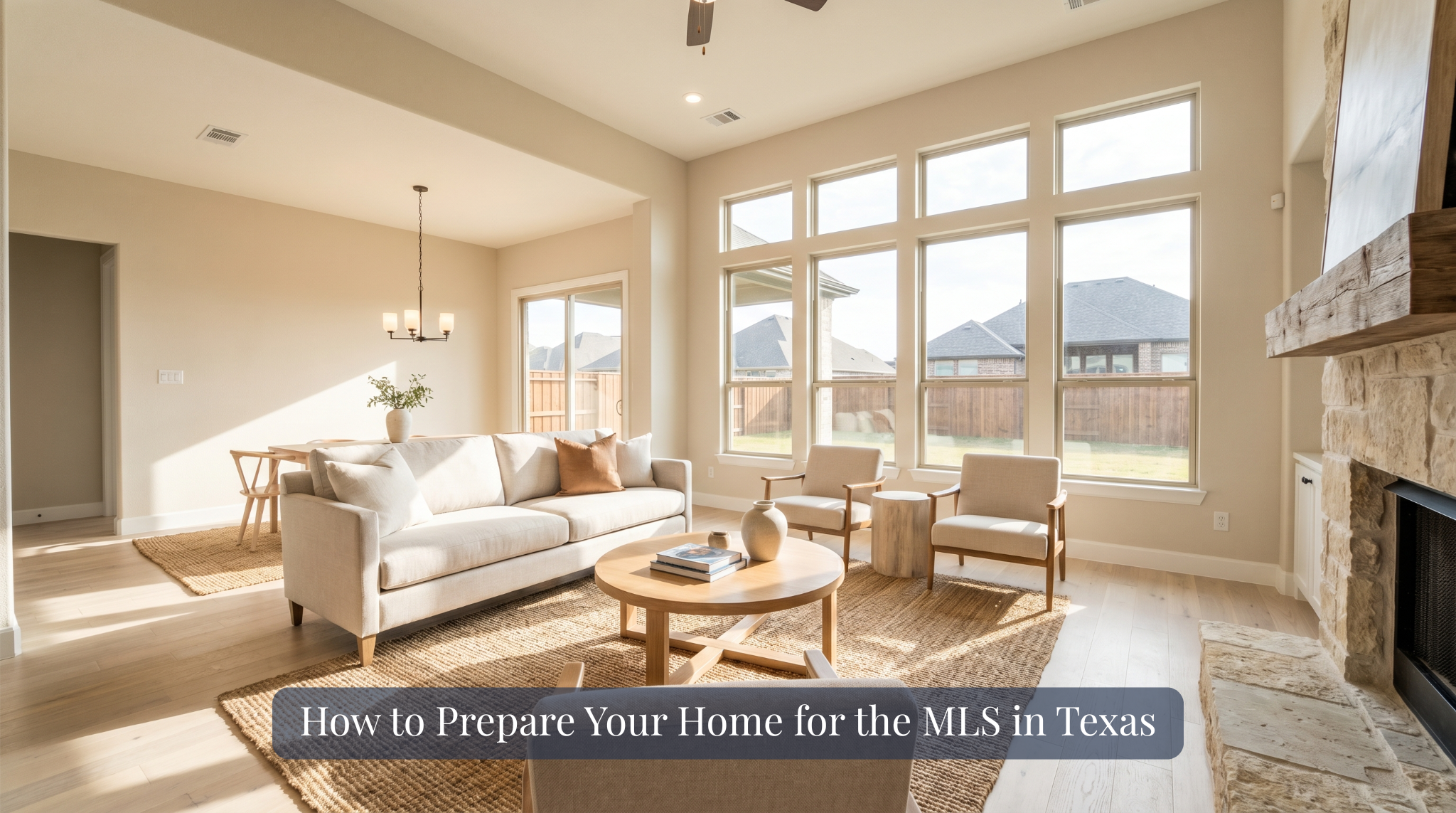
Your MLS listing is the first thing every buyer's agent in your market sees. Before a single buyer visits in person, they have already made a judgment based on your photos, your listing description, and whatever the property data shows. Most Texas sellers spend months deciding to sell and then rush the preparation that determines how fast and at what price they close. This guide covers what actually moves the needle.
- Why the first week on market is the one that counts
- Photos: what buyers and agents actually look for
- Virtual staging and photo enhancement
- How to write a listing description that works
- Pre-listing preparation checklist
- Should you get a pre-listing inspection?
- Texas MLS photo and description rules by board
- How Aria prepares your listing
- Frequently asked questions
Why the first week on market is the one that counts
In Texas real estate, the first seven days of a listing determine more about your final sale price than almost any other factor. Buyers and agents monitor new listings closely. A home that generates strong showing activity in week one attracts multiple offers, which gives you negotiating leverage. A home that sits for three weeks with limited showings signals something is wrong, and that signal is difficult to undo even with a price reduction.
The factors that drive first-week showings are almost entirely within your control before you go live. Photos, listing description, and property condition all happen before the MLS submission date. Getting them right is the preparation that matters.
Photos: what buyers and agents actually look for
Most buyers in Texas find your home on Zillow, Realtor.com, Redfin, or Homes.com before they ever contact an agent. They make their initial showing decision based entirely on photos. A buyer who skips your listing because the photos look dark, cluttered, or incomplete will not come back. A competing listing with better photos will get the showing instead.
What to photograph
Every room should be photographed from the doorway angle. This gives buyers the most complete sense of the space and is the standard framing that trained photographers use. Beyond full room shots, these specific areas drive the most showing decisions:
- Exterior front. Shoot in morning or late afternoon light when shadows are soft and the sun is not directly behind the photographer. This is the first photo most buyers see and should be among your strongest.
- Kitchen. The kitchen sells homes more consistently than any other room. Photograph it clean, with counters cleared, and in the best light available. If the kitchen has been updated in the last five years, that should be obvious in the photo.
- Primary bathroom. Clean mirrors, no personal items visible, toilet lid down. Buyers notice bathroom photos immediately.
- Primary bedroom. Made bed, neutral staging if possible, natural light.
- Outdoor spaces. Backyard, patio, covered area, and curb appeal shot from the street. Texas buyers care about outdoor living.
- Any significant update. New roof, new HVAC, renovated bathroom, updated flooring. If you spent money on it, photograph it.
How many photos to include
Most Texas MLS boards allow up to 40 photos. SABOR in San Antonio, HAR in Houston, ACTRIS in Austin, and NTREIS in Dallas-Fort Worth all support high photo counts. You do not need 40 photos on a two-bedroom home, but listings with 20 or more quality photos consistently generate more showing requests than listings with fewer. When in doubt, include more rather than fewer.
Photo quality basics
Photos should be sharp, well-lit, and taken with a wide-angle lens that shows the full room without distortion. Horizontal shots work better than vertical for MLS systems. Each photo should be at least 1024 pixels wide. Dark, blurry, or vertical phone photos tell buyers and agents that the seller did not prepare the listing carefully, which affects their perception of how the property was maintained.
Virtual staging and photo enhancement
Empty rooms photograph poorly. Without furniture, buyers struggle to understand scale, flow, and how a space would actually be used. A living room with no furniture looks smaller than the same room with a couch and coffee table. A dining area with no table looks like a hallway.
Virtual staging adds furniture and decor digitally to photos of empty rooms. It produces professional listing photos without the cost or logistics of physical staging, which in Texas typically runs $1,500 to $3,000 for a furnished consultation. Photo enhancement improves lighting, sharpens details, and corrects color balance in existing photos.
Aria handles both as part of your Waymark listing. When you upload your photos, Aria stages empty rooms, enhances lighting, and prepares listing-ready images before your home goes live on the MLS.
How to write a listing description that works
Your MLS listing description has one job: give buyers and agents enough specific information to decide whether to schedule a showing. It is not marketing copy. It is not a sales pitch. It is a factual summary of what makes the property worth seeing in person.
Length and format
A Texas MLS listing description should be 150 to 250 words. Shorter than 150 words leaves out information buyers need. Longer than 250 words tends to include filler that buyers skip. Most MLS systems display the first two to three lines before requiring a click to expand, so the first sentence should contain your most important information.
What to include
- Bedroom and bathroom count (this is usually populated separately in MLS fields, but reference it briefly)
- Any updates made in the last five years: roof, HVAC, kitchen, bathrooms, flooring
- Neighborhood name and any relevant nearby landmarks, employers, or schools
- Standout features: covered patio, pool, large lot, corner location, cul-de-sac, greenbelt
- Practical information buyers need: HOA or no HOA, any notable restrictions, garage size
What to avoid
Avoid superlatives like "stunning," "gorgeous," "one of a kind," and "must see." Buyers have read thousands of listings and these words carry no information. Avoid urgency language like "won't last" or "priced to sell quickly." Avoid vague phrases like "great bones" or "tons of potential," which buyers read as signals of deferred maintenance. Stick to specific and factual language.
Example of a weak versus strong opening
Weak: "Gorgeous home in a great neighborhood. Stunning kitchen and beautiful backyard. Must see!"
Strong: "3-bedroom, 2-bath home on a quiet cul-de-sac in Stone Oak. Kitchen updated 2022 with quartz countertops and new appliances. New roof 2023. Covered patio and oversized backyard. Walking distance to Reagan High School."
The second version gives a buyer something to act on. The first version gives them nothing.
Pre-listing preparation checklist
This checklist covers what to complete before your photographer arrives and before your listing goes live. The goal is a home that photographs well and shows well on day one.
Declutter and depersonalize
- Remove personal photos from walls and surfaces
- Clear kitchen counters to a minimum of appliances
- Remove excess furniture from rooms that feel crowded
- Clear closets to roughly 50% capacity so they photograph larger
- Remove religious items, political items, and anything personally identifying
- Rent a storage unit if needed rather than piling items in the garage
Deep clean
- Clean all windows inside and outside
- Clean baseboards and door frames
- Clean inside appliances if buyers will open them during showings
- Clean grout in kitchens and bathrooms
- Remove any visible mold or mildew
- Have carpets professionally cleaned if they show wear or odor
Maintenance items
- Replace burned-out light bulbs in every fixture
- Fix leaky faucets and running toilets
- Repair obvious damage: holes in walls, broken handles, stuck doors
- Touch up paint where it is visibly scuffed or chipped
- Confirm all doors, windows, and locks function correctly
- Test smoke detectors and carbon monoxide detectors
Exterior and curb appeal
- Mow lawn and edge borders
- Trim overgrown shrubs and trees
- Clear walkways and driveway of debris
- Power wash driveway, walkway, and exterior if needed
- Clean or replace front door hardware
- Add a clean doormat if yours is worn
- Remove yard clutter: old pots, tools, equipment
Day of photography
- Turn on all lights in every room
- Open all blinds and curtains
- Remove cars from the driveway and front of the house
- Remove pets and pet items from visible areas
- Set the thermostat to a comfortable temperature
- Put away trash cans
Should you get a pre-listing inspection in Texas?
A pre-listing inspection is not required to sell your home in Texas, but it is a strategically useful step for many sellers. Here is how to think through the decision.
Arguments for a pre-listing inspection
When a buyer's inspector identifies a problem during the option period, you are negotiating under time pressure and within a contract you have already signed. You have little leverage to push back on repair estimates because the buyer can walk away with their earnest money if you refuse. A pre-listing inspection gives you the same information, but on your timeline. You can get your own contractor estimates, decide what to repair and what to disclose as-is, and price the home accordingly.
A pre-listing inspection also strengthens your Texas Seller's Disclosure Notice. The disclosure asks you to represent the condition of major systems based on your knowledge. Completing an inspection before listing gives you verifiable, documented knowledge of your home's condition, which reduces legal exposure after closing.
Arguments against a pre-listing inspection
Anything a pre-listing inspector finds must be disclosed to buyers, even if you choose not to repair it. If the inspection reveals significant issues, you may be in a better position to negotiate those issues during the contract process rather than disclosing them upfront and allowing buyers to factor them into their offer price. Some sellers prefer to let the buyer's inspector surface issues and negotiate from there.
What a pre-listing inspection costs in Texas
A pre-listing home inspection in Texas typically costs between $300 and $500 for a standard single-family home. Larger homes, older homes, or homes with pools, septic systems, or additional structures cost more. A licensed Texas inspector issues a written report using the TREC inspection report format.
Texas MLS photo and description rules by board
Each Texas MLS board has its own rules about photos, descriptions, and listing data. The rules below reflect current standards as of 2026. Confirm with your broker before submitting.
SABOR — San Antonio
SABOR requires at least one exterior photo on every residential listing. Maximum photo count is 40. Listing descriptions cannot include contact information, website URLs, or compensation offers. Descriptions are limited to 1,000 characters.
HAR — Houston
HAR requires at least one photo on every active listing. Maximum 40 photos. Listing remarks are split into public remarks (visible to buyers and agents) and private remarks (visible only to agents). Public remarks cannot include agent contact information or showing instructions. Length limit is 1,024 characters for public remarks.
ACTRIS — Austin
ACTRIS requires at least one exterior photo. Maximum photo count is 40. Public remarks must be factual property descriptions. Agent names, phone numbers, and URLs are not permitted in public remarks. Character limit is 1,000.
NTREIS — Dallas-Fort Worth
NTREIS requires at least one photo on every active listing. Maximum 40 photos. Public remarks are limited to property descriptions and cannot include contact information. Character limit is 1,000 characters.
How Aria prepares your listing
Preparing a home for the MLS involves a specific sequence of tasks: photos uploaded, images enhanced, listing description written, property data confirmed, and everything reviewed before submission. Aria handles the parts that used to require a photographer, a copywriter, and a marketing coordinator.
When you set up your Waymark listing, Aria stages empty rooms and enhances your photos before your listing goes live. Aria writes your MLS description using the specific features and updates you provide, formatted within the character limits of your local board. Aria also generates a property flyer, social media posts, and yard sign assets from the same listing data, so your marketing is ready the day your listing is approved.
Before your home goes live, a licensed broker through Marelli Properties reviews your listing for fair housing compliance, stronger listing remarks, and MLS readiness. The combination of AI preparation and broker review means your listing enters the market the way well-prepared listings enter the market: with strong photos, accurate data, and a description that gives buyers a reason to schedule a showing.
Frequently asked questions
How do I prepare my home for the MLS in Texas?
Start with the pre-listing checklist above: declutter, deep clean, complete visible maintenance items, and improve curb appeal before your photographer arrives. Have professional-quality photos taken with all lights on, blinds open, and personal items removed. Write a 150 to 250 word description focused on specific updates and features. Submit your listing through a licensed Texas broker for review before it goes live.
How many photos does a Texas MLS listing need?
Most Texas MLS boards including SABOR, HAR, ACTRIS, and NTREIS allow up to 40 photos. Listings with 20 or more quality photos consistently generate more showing activity than listings with fewer. Every room should be photographed. Kitchen, bathrooms, primary bedroom, exterior, and any significant updates are the priority shots.
How long should a Texas MLS listing description be?
150 to 250 words is the effective range. Include specific updates, standout features, and neighborhood context. Avoid superlatives and urgency language. The first sentence should contain the most important information about the property since most MLS platforms truncate the description in search results.
Should I get a pre-listing inspection in Texas?
A pre-listing inspection is optional but strategically useful for sellers who want to understand their home's condition before buyers see it. It gives you time to repair items on your schedule, strengthens your seller disclosure, and removes the negotiating disadvantage of discovering problems under contract pressure. Cost is typically $300 to $500 for a standard single-family home.
What happens if my MLS listing photos are poor quality?
Buyers make their initial showing decision based entirely on photos. Poor or insufficient photos result in buyers moving on to competing listings. First-week showing activity is one of the strongest predictors of a final sale price at or above asking. Getting photos right before going live is more valuable than any price adjustment made after the listing sits.
Reviewed by a licensed Texas broker. Content reflects Texas real estate practice as of March 2026. Marelli Properties, TREC License 639078.
See how Waymark prepares your listing
Aria stages your photos, writes your listing description, and generates your marketing before your home goes live. A licensed Texas broker reviews everything before submission. Flat fee from $699. No listing commission at closing.
Start my listing at waymarkre.com