Updated June 2026 | Waymark Real Estate | TREC License 639078
You have 2.7 seconds. That is how long a buyer scrolling Zillow or Redfin on their phone spends on your listing before deciding whether to look closer or swipe past. The first three images determine whether your home gets a showing or gets ignored.
The data is not subtle. A VHT Studios analysis of over 200,000 listings found that professionally photographed homes sell 32% faster and for $3,400 to $11,200 more than comparable homes with amateur photos. They receive 118% more online views and nearly triple the number of serious buyer inquiries.
In the current Texas market, where inventory is rising and homes are spending a median of 67 days on market statewide, up 23% from 2024, listing photos are no longer a nice-to-have. They are the difference between selling in three weeks and sitting for three months.
This guide covers how to prepare your home, what to photograph, what it costs in Texas, and how to use the photos to generate the most buyer interest.
- Why Listing Photos Are Your Highest-ROI Investment
- How to Prepare Your Home Before the Shoot
- What to Photograph and in What Order
- Hiring a Photographer in Texas: What to Look For
- What Real Estate Photography Costs in Texas
- DIY Photos: When They Work and When They Do Not
- Virtual Staging: What It Is and When to Use It
- Video and Drone: What Is Worth the Investment
- How to Use Your Photos to Maximize Buyer Interest
- How Waymark Handles Listing Photography
- Frequently Asked Questions
Why Listing Photos Are Your Highest-ROI Investment
The math on listing photos is among the clearest in all of real estate marketing. Here is what the data shows:
- Professionally photographed homes sell 32% faster, spending 89 days on market versus 123 days for homes with amateur photos, according to Cubi Casa's 2026 analysis of industry data
- Professional photos produce $3,400 to $11,200 more in sale price on comparable listings, according to research cited by the Wall Street Journal
- Listings with professional images receive 118% more online views, according to PhotoUp's 2025 compilation of real estate photography statistics
- 70% of buyers skip listings with low-quality photos entirely — they never even click through to read the description
- The first three images determine whether the buyer engages with the rest of the listing
A professional photo shoot in Texas costs $50 to $300 for a standard residential home, according to Skylum's 2026 pricing survey. On a home where professional photos generate even $3,400 more in sale price, that is a return of 10x to 60x on the investment. No other single expense in the selling process produces that kind of return.
How to Prepare Your Home Before the Shoot
The photographer captures what is there. Your job is to make sure what is there is worth capturing. Preparation takes one full day and it is the difference between photos that generate showings and photos that sit in a listing no one clicks.
Declutter every surface
Remove everything from kitchen countertops except one or two decorative items. Clear bathroom vanities completely. Remove personal photos from walls and shelves. Take the magnets and papers off the refrigerator. Store shoes, coats, and bags out of sight. The goal is not to make the home look unlived in. The goal is to make every room feel larger and let the buyer imagine their own belongings in the space.
Deep clean before the photographer arrives
Clean windows inside and out. Buyers notice dirty windows in photos because they affect the light quality in every room. Mop and vacuum all floors. Clean baseboards and light switch plates. Make beds with simple, neutral bedding. The camera captures dirt and clutter that the human eye overlooks in person.
Maximize natural light
Open every curtain and blind. Turn on every light in the house, including closet lights, under-cabinet lights, and lamps. Replace any burned-out bulbs. The combination of natural light and ambient interior lighting produces the warm, bright quality that makes listing photos feel inviting rather than dark and cramped.
Handle the exterior before the interior
Mow the lawn. Edge the walkways. Clean the driveway and front porch. Remove trash cans, garden hoses, and any stored items from view. Trim bushes that block windows or the front entry. The exterior is the first photo in most MLS listings and it sets the buyer's expectation for everything that follows.
Remove vehicles from the driveway
Cars in the driveway make the home look lived-in rather than available. Move all vehicles to the street or around the corner before the shoot. An empty driveway and clear garage front make the property feel move-in ready.
What to Photograph and in What Order
The sequence of photos in your MLS listing tells a story. The buyer should feel like they are walking through the home from the curb to the backyard. Here is the order that generates the most engagement:
- Photo 1: Front exterior. This is the most important photo in the entire listing. It determines whether the buyer clicks. Shoot at a slight angle, not dead center. Include the full front elevation, landscaping, and sky.
- Photos 2 to 3: Main living areas. The living room and family room. Shoot from corners to maximize the sense of space. Wide-angle lenses make rooms feel larger but do not over-distort or the buyer will feel deceived at the showing.
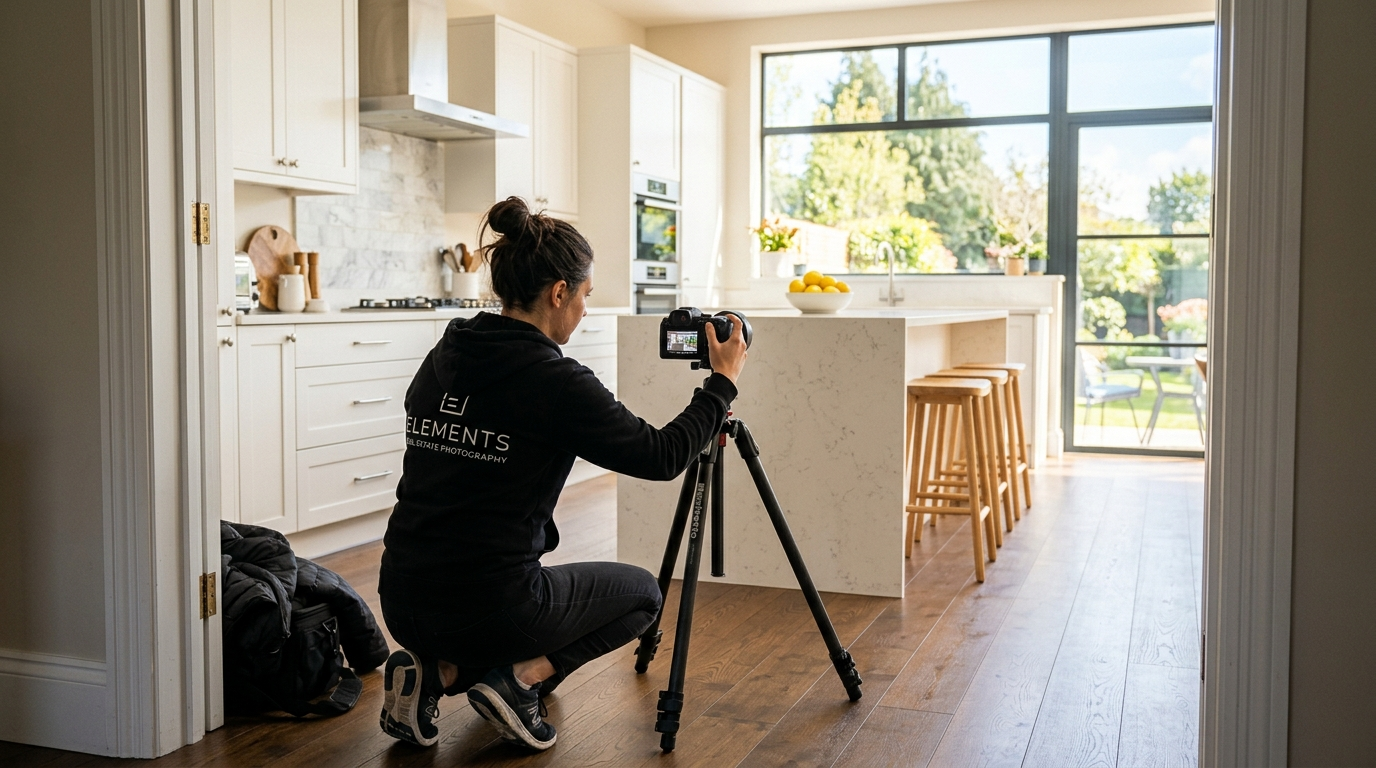
- Photos 4 to 5: Kitchen. The kitchen sells more homes than any other room. Shoot from the main entry point into the kitchen showing the full layout. If you have a kitchen island, make it the focal point. Clean countertops are essential.
- Photos 6 to 7: Primary bedroom and bathroom. The primary suite is the second most important interior space. Make the bed. Clear the nightstands. In the bathroom, close the toilet lid, remove all personal products, and put out fresh towels.
- Photos 8 to 10: Secondary bedrooms, bathrooms, and office. Each room gets one to two photos. Clean and decluttered.
- Photos 11 to 12: Special features. Pool, outdoor kitchen, large backyard, view, garage workshop, or any feature that differentiates your home from comparable listings in the area.
- Photo 13: Backyard exterior. The closing photo. Shoot from the patio or back door looking out. If the yard is the strongest feature, put this photo earlier in the sequence.
Most MLS boards allow 25 to 40 photos per listing. A standard professional real estate photo package includes 15 to 25 finished images. For a typical three-bedroom Texas home, 20 to 25 photos is the right range. More than 30 creates scroll fatigue. Fewer than 15 leaves gaps that make buyers wonder what you are not showing.
Hiring a Photographer in Texas: What to Look For
Not every photographer can shoot real estate effectively. Real estate photography requires specific equipment, specific techniques, and an understanding of how buyers consume listing photos on a phone screen.
What to look for in a portfolio
Look for consistent quality across different property types and lighting conditions. Rooms should look bright and spacious without extreme distortion. Exteriors should have balanced exposure between the home and the sky. Colors should look natural, not oversaturated. If the portfolio is full of photos that make every room look like a hotel lobby, the photographer is over-editing. Buyers respond to images that look real and inviting, not artificial.
Questions to ask before booking
- Do you specialize in real estate or is this a sideline? Dedicated real estate photographers understand MLS requirements, optimal shooting times, and how to handle tricky Texas afternoon light.
- What equipment do you use? A wide-angle lens (16mm to 35mm range), a tripod, and flash or HDR capability are the baseline for professional real estate work.
- How many edited images are included in the base price?
- What is the turnaround time? In a competitive market, 24 to 48 hour delivery matters. If the photographer takes a week to deliver, your listing launch is delayed.
- Do you offer drone photos and video as add-ons?
Where to find real estate photographers in Texas
Search "real estate photographer" plus your city name on Google. Check reviews on Google Business Profile and Yelp. Ask your title company or neighboring agents for referrals. In Houston, San Antonio, Austin, and Dallas there are dozens of dedicated real estate photographers competing for business. Pricing is competitive and quality is generally high.
What Real Estate Photography Costs in Texas
Texas is one of the more affordable states for real estate photography. Standard photo packages in Texas typically cost between $50 and $180 for homes under 2,000 square feet, according to Skylum's 2026 pricing analysis. Larger homes and premium services cost more.
| Service | Typical Texas Cost |
|---|---|
| Standard photo package (15 to 25 images) | $50 to $250 |
| HDR / premium photo package | $200 to $500 |
| Drone / aerial photography (add-on) | $100 to $300 |
| Video walkthrough | $200 to $800 |
| 3D virtual tour (Matterport or similar) | $200 to $500 |
| Virtual staging (per room) | $25 to $75 |
| Twilight / dusk exterior (add-on) | $100 to $200 |
Sources: Skylum 2026 Pricing Survey; Luxury Presence 2026 Photography Pricing Guide; Square Foot Photography Texas Pricing 2026
For most Texas homes in the $250,000 to $500,000 range, a standard photo package of 20 to 25 images is the right investment. The return on a $150 photo shoot that generates even one additional interested buyer is measured in thousands of dollars, not hundreds.
DIY Photos: When They Work and When They Do Not
Modern smartphone cameras are genuinely capable. An iPhone 15 or newer Samsung Galaxy in good lighting with a clean lens can produce listing-quality photos for certain situations.
DIY photos can work when: You are listing a rental property, a vacant lot, or a home priced under $150,000 where the commission savings from FSBO make the cost of a photographer proportionally high. If you have photography experience and understand composition and lighting, your results may be comparable to a budget photographer.
DIY photos do not work when: The home has challenging lighting (dark rooms, strong afternoon sun through west-facing windows), small rooms that need wide-angle treatment, or is competing against professionally photographed listings in the same price range. In a balanced or buyer's market where your home is one of fifteen active listings in the neighborhood, professional photos are not optional. They are the cost of competing.
If you do shoot your own photos, follow these rules: shoot during morning or late afternoon for the best natural light, clean your phone lens before every shot, shoot horizontally (never vertically for MLS photos), shoot from doorways and corners to maximize room depth, and take 50 to 75 photos so you can select the best 20 to 25 for the listing.
Virtual Staging: What It Is and When to Use It
Virtual staging uses software to digitally furnish empty rooms in listing photos. Virtually staged listings receive 40% more online views than vacant room photos, according to Florida Realtors data cited by Roomagen.
Virtual staging costs $25 to $75 per room, making it dramatically cheaper than physical staging which runs $2,000 to $5,000 or more for a full home. For vacant properties, virtual staging is nearly always worth the investment because empty rooms photograph poorly. Buyers struggle to judge scale and imagine furniture placement in a featureless empty space.
Two important notes on virtual staging for Texas sellers: First, most MLS boards require you to disclose that photos are virtually staged. Include "virtually staged" in the photo caption or listing description. Second, the staging should be realistic. Furniture that is wildly oversized, undersized, or stylistically inconsistent with the home's market creates a negative impression rather than a positive one.
Video and Drone: What Is Worth the Investment
Drone photography
Listings with drone photography sell 68% faster than those without, according to industry data compiled by Roomagen. Drone photos are most valuable for homes with large lots, pool areas, acreage, waterfront access, or proximity to desirable features like parks or golf courses. For a standard subdivision lot under a quarter acre, aerial photos are less impactful because the context they provide is less differentiated.
FAA regulations require drone operators to hold a Part 107 Remote Pilot Certificate. Verify your photographer has one before booking aerial work. Most dedicated real estate photographers in Texas markets include drone capability as a standard add-on.
Video walkthroughs
Listing videos generate 403% more inquiries according to REA Group data. However, video production costs $200 to $800 for a standard walkthrough and $500 to $1,500 or more for cinematic productions. The ROI calculation depends on your home's price point. For homes above $400,000, a professional video walkthrough is worth the investment. For homes below that threshold, a well-shot slideshow of your professional photos often performs comparably at a fraction of the cost.
A 60 to 90 second walkthrough clip shot on a smartphone with a gimbal stabilizer is a free alternative that provides meaningful value above photos alone, even without professional production quality.
How to Use Your Photos to Maximize Buyer Interest
Professional photos are only as effective as how you deploy them. Getting the photos is step one. Putting them in front of the right buyers in the right sequence is step two.
MLS listing order
The first photo is the cover photo. It appears in every search result, every Zillow grid, every Redfin card. It must be the strongest exterior shot at the best time of day. The second and third photos should be the kitchen and the main living area. These three images determine whether the buyer clicks through to see the remaining photos. Everything after that follows the walkthrough sequence described above.
Social media
Select your five strongest photos and create a carousel post for Facebook and Instagram. Lead with the exterior, then the kitchen, then the feature that most differentiates your home. Include the price, address, and a link to the full listing in the caption. Aria generates social media post content from your listing data so you do not have to write the captions from scratch.
Listing description
Your photos and your listing description should tell the same story. If your strongest photo is the backyard pool, your description should mention the pool early. If your kitchen renovation is the standout feature, lead the description with it. Inconsistency between what the photos show and what the description emphasizes confuses buyers and reduces engagement.
How Waymark Handles Listing Photography
Waymark's platform is designed for sellers who are managing their own listing with AI-guided support. When it comes to photography, here is how Fixed-Rate Selling handles it:
Aria generates your complete listing description, marketing flyers, and social media posts from the information and photos you provide. The platform gives you everything you need to market your home professionally once the photos exist.
For the photos themselves, you have two paths. You can hire a local real estate photographer directly using the guidance in this article. In Texas, that typically costs $50 to $250 for a standard package. Or if budget is a concern, you can shoot your own photos following the preparation and shooting guidelines above and let Aria build the marketing suite around them.
The photography investment is separate from the Waymark fixed price. This is intentional. In the traditional agent model, photography is bundled into the 3% commission along with dozens of other services, making it impossible to know what you are actually paying for each one. In the Fixed-Rate Selling model, every cost is visible and every decision is yours.
The first Waymark transaction closed on June 2, 2026 in Universal City, Texas. The seller kept $4,351 that a traditional 3% listing commission would have taken. Professional photos were part of the listing. The total photography cost was a fraction of the savings.
Frequently Asked Questions
How much do listing photos cost in Texas?
Standard real estate photography packages in Texas cost $50 to $250 for 15 to 25 edited images, depending on home size and photographer experience. HDR and premium packages run $200 to $500. Drone add-ons cost $100 to $300. Virtual staging costs $25 to $75 per room. Texas is among the more affordable states for real estate photography.
Do professional photos really make a difference?
Yes. The data is consistent across multiple studies. Professionally photographed homes sell 32% faster, receive 118% more online views, and sell for $3,400 to $11,200 more than comparable listings with amateur photos. In a market where homes are sitting longer than they did in 2021 or 2022, professional photos are one of the most effective tools for reducing time on market.
Can I use my smartphone for listing photos?
Modern smartphones produce acceptable results in good lighting conditions for certain property types. However, professional photographers bring wide-angle lenses, HDR processing, flash techniques, and composition expertise that consistently outperform smartphone cameras. If your home is competing against professionally photographed listings in the same price range, smartphone photos put you at a measurable disadvantage.
What is virtual staging and is it worth it?
Virtual staging uses software to digitally place furniture into photos of empty rooms. It costs $25 to $75 per room and generates 40% more online views than vacant room photos. For vacant properties, virtual staging is almost always worth the investment. Most Texas MLS boards require you to disclose that photos are virtually staged.
When is the best time of day to photograph a home in Texas?
Early morning (8am to 10am) and late afternoon (4pm to 6pm) produce the best natural light for Texas homes. Midday sun in Texas creates harsh shadows and washed-out exposures, especially on south and west-facing exteriors. Twilight exterior shots (taken just after sunset) are a premium add-on that can be extremely effective for homes with good exterior lighting.
How many photos should I include in my MLS listing?
For a typical three-bedroom Texas home, 20 to 25 photos is the right range. Fewer than 15 leaves gaps. More than 30 creates scroll fatigue. Lead with your strongest exterior, then kitchen, then main living area. The first three photos determine whether the buyer engages with the rest.
Does Waymark provide a photographer?
Waymark's Fixed-Rate Selling model keeps photography costs separate and transparent so you control the investment. You hire a local real estate photographer directly or shoot your own photos. Aria then builds your complete listing description, marketing flyers, and social media posts from the photos and property data you provide. The photography cost is typically $50 to $250 in Texas, a fraction of the $8,000 or more you save by choosing Fixed-Rate Selling over a traditional 3% listing commission.
Keep your equity. That's Waymark.
Waymark is the licensed AI brokerage that created Fixed-Rate Selling for Texas home sellers. Full MLS exposure across HAR, SABOR, ACTRIS, and NTREIS. AI that handles the process. A licensed broker that handles the risk. One fixed price starting at $699. No percentage extraction.
Start your listing at waymarkre.com
Waymark Real Estate | TREC License 639078 | Brokered by Marelli Properties
Related Articles
- How to Sell Your Home Without a Realtor in Texas
- How to Price Your Home Without a Listing Agent in Texas
- How Long Does It Take to Sell a House in Texas?
- What Is Fixed-Rate Selling?
Sources
- imgix / VHT Studios, The Power of Images in Real Estate: What the Data Reveals, December 2024 (analysis of 200,000+ listings)
- Cubi Casa, Why Real Estate Photography Is the Secret to Selling Homes Faster in 2026, January 2026
- PhotoUp, 90+ Key Real Estate Photography Statistics and Trends for 2025, June 2025
- Roomagen, 90+ Real Estate Photo Statistics and Trends 2026, April 2026
- Skylum, How Much Do Real Estate Photographers Charge? 2026, April 2026
- Luxury Presence, The Savvy Agent's Guide to Real Estate Photography Pricing in 2026, April 2026
- Square Foot Photography, What Is the Cost of Real Estate Photos in Texas Markets in 2026, January 2026
- Blue Bend Photography, Real Estate Photography: What the Market Needs in 2026, May 2026