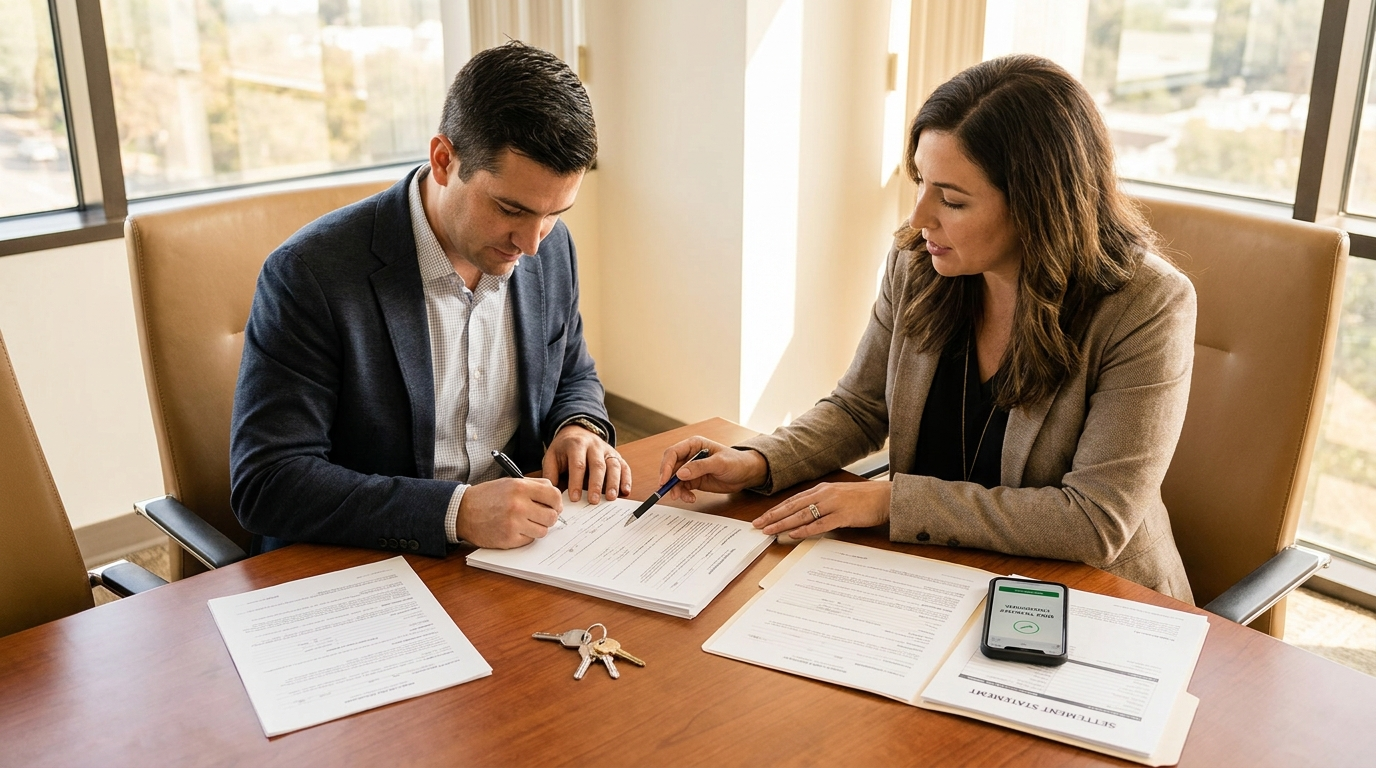
If you are selling your Texas home without a traditional listing agent, closing is the moment that can feel the most uncertain. You handled the listing, managed the showings, worked through the offer, survived the inspection, and now you are sitting down to sign documents and transfer ownership.
Here is what most sellers discover at this point: closing is handled by the title company, not by the listing agent. Whether you sold with a traditional agent, a flat fee MLS service, or a Fixed-Rate Selling platform like Waymark, the closing process is the same. The title company manages the documents, the escrow, the lien payoffs, and the fund disbursement. The listing agent's role at closing is limited. Yours does not have to be.
This guide walks through exactly what happens at a Texas closing from the seller's side so nothing catches you off guard on the day your equity hits your bank account.
- What Happens Before Closing Day
- What Happens at Closing
- Who Is in the Room
- What You Sign as the Seller
- When You Get Paid
- Wire Fraud: The Risk No One Talks About Until It Is Too Late
- Your Closing Day Checklist
- How Waymark Handles the Closing Process
- Frequently Asked Questions
What Happens Before Closing Day
The closing date was set in the contract, typically 30 to 45 days after the executed agreement. But several things need to happen between the contract and the closing table.
Title work
The title company searches public records to confirm you have clear ownership of the property and that there are no liens, judgments, or encumbrances that would prevent the transfer. This process takes one to two weeks. If title issues are found (an old lien that was never released, a recording error, or a boundary dispute), they must be resolved before closing can proceed.
Buyer's appraisal
If the buyer is using a mortgage, the lender orders an appraisal to confirm the home's value supports the loan amount. If the appraisal comes in below the contract price, the buyer may ask you to reduce the price, bring the difference in cash, or terminate the contract depending on the terms. This is one of the four moments in a Texas transaction where the most money changes hands.
Inspection and repairs
The buyer's inspection typically happens during the option period. If the buyer requests repairs or credits, those negotiations happen through an amendment to the contract. Whatever was agreed in the repair amendment will be reflected on your closing statement as a credit to the buyer.
Closing disclosure review
The title company prepares a settlement statement showing every dollar in the transaction: the sale price, your mortgage payoff, closing costs, credits, prorations, and your net proceeds. Review this document carefully before closing day. Every number on this page affects how much money you walk away with. If something does not match what was agreed in the contract, raise it with the title company before you sign.
Mortgage payoff
Your lender provides a payoff statement to the title company showing the exact amount needed to satisfy your mortgage as of the closing date. This includes remaining principal, accrued interest, and any fees. The title company pays your lender directly from the sale proceeds at closing.
What Happens at Closing
Closing in Texas is handled entirely by the title company. Texas does not require an attorney at closing for residential real estate transactions, though you can bring one if you want legal review of the documents.
Texas is a "wet funding" state, which means funds are disbursed on the same day the documents are signed and the deed is recorded. In some states, there is a gap between signing and funding. In Texas, it typically happens the same day.
The closing itself usually takes 30 to 60 minutes for the seller. You will sign significantly fewer documents than the buyer. The buyer signs 50 to 100 pages of loan documents. You sign the deed, the settlement statement, and a handful of affidavits. The title company walks you through each one.
In many Texas transactions, the buyer and seller sign separately. You do not have to be in the same room at the same time. Some title companies also offer remote online notarization for sellers who cannot appear in person.
Who Is in the Room
At a typical Texas closing, the seller's side of the table includes:
- You (the seller). You are signing the deed and the settlement statement. If there are two sellers on the title (married couple, co-owners), both need to sign.
- The title company closing officer. This person manages the entire signing process, explains each document, notarizes signatures, and handles the escrow disbursement. They are the one running the closing.
- Your broker (optional). On a Waymark Manage plan, your broker coordinates with the title company on key milestones and reviews the closing disclosure before you sign. On a Launch plan or a flat fee service, your broker may not be present. This does not change the closing process because the title company handles everything.
- Your attorney (optional). Texas does not require a closing attorney for residential sales. If you have a complex transaction (estate sale, divorce, title issues, or commercial property), an attorney may be worth having present.
The buyer and their agent are usually signing in a separate appointment or at the same table depending on the title company's process. Either way, the title company manages both sides.
What You Sign as the Seller
Sellers sign far fewer documents than buyers. Here is what to expect:
| Document | What It Does | What to Check |
|---|---|---|
| General warranty deed | Transfers ownership of the property from you to the buyer. This is the most important document you sign. | Confirm your name is spelled correctly and the legal description matches your property. |
| Settlement statement (closing disclosure) | Shows every dollar in the transaction: sale price, credits, costs, mortgage payoff, prorations, and your net proceeds. | Verify every line item. Confirm repair credits match the amendment. Confirm commission amounts match the contract. Confirm the property tax proration is calculated correctly. |
| Owner's affidavit (T-47 or title affidavit) | You attest that you are the legal owner, that there are no undisclosed liens or claims, and that no changes have been made to the property boundaries since the survey. | Read carefully. You are making legal representations about the property's title status. |
| IRS Form 1099-S authorization | Authorizes the title company to report the sale to the IRS. The sale proceeds are reported on Form 1099-S. | Confirm the sale price and your Social Security Number or Tax ID are correct. |
| FIRPTA affidavit | You certify that you are not a foreign person for tax purposes. This determines whether the buyer must withhold a portion of the sale price for federal taxes. | Standard form. Sign it if you are a U.S. citizen or resident alien. |
| Utility transfer authorization | Authorizes the transfer of utility accounts to the buyer as of the closing date. | Confirm the effective date matches your closing date. |
The total signing time for sellers is typically 15 to 30 minutes. The title company closing officer will explain each document as you sign. If anything is unclear, ask before you sign. Once the deed is recorded, the transfer is final.
When You Get Paid
In Texas, sellers typically receive their proceeds the same day as closing or within one business day.
Here is how the money flows:
- The buyer's lender wires the loan funds to the title company's escrow account.
- The title company pays off your existing mortgage directly from the sale proceeds.
- The title company deducts all closing costs, commissions, credits, prorations, and fees from the remaining proceeds.
- The title company wires your net proceeds to your bank account or issues a check.
Most sellers choose a wire transfer, which arrives the same day or next business day. If you choose a cashier's check, you receive it at the closing table but should be aware that large check deposits may have a hold period at your bank.
Your net proceeds are the sale price minus everything that was deducted: mortgage payoff, closing costs, any listing fee or commission, property tax proration, repair credits, and title company fees. The settlement statement shows every deduction line by line. Review it before closing so you know exactly what to expect.
Wire Fraud: The Risk No One Talks About Until It Is Too Late
Wire fraud in real estate transactions is a serious and growing risk. Criminals intercept email communications between buyers, sellers, agents, and title companies, then send fraudulent wiring instructions that redirect closing funds to accounts they control.
This does not just happen to buyers. Sellers receiving proceeds via wire transfer are also targets.
How to protect yourself:
- Never wire funds based solely on emailed instructions. Always verify wiring instructions by calling the title company directly at a phone number you obtained independently (from their website or your original paperwork, not from the email).
- If you receive an email saying "our wiring instructions have changed," treat it as a red flag. Title companies almost never change wiring instructions mid-transaction.
- Confirm your bank account information with the title company in person or by phone before closing day. The title company should already have your wiring details on file.
- If something feels off, stop and call. A legitimate title company will never pressure you to wire money without proper verification.
The FBI's Internet Crime Complaint Center reported over $446 million in losses from real estate wire fraud in 2024. One phone call to verify instructions can prevent your entire sale proceeds from being stolen.
Your Closing Day Checklist
Bring the following to your closing appointment:
- Government-issued photo ID. The title company will verify your identity before you sign the deed. A driver's license or passport works.
- Your bank account information for wire transfer. If you are receiving proceeds via wire, confirm your routing and account numbers with the title company before closing day.
- Keys, garage remotes, and gate codes. You are transferring possession. Bring everything the buyer needs to access the property.
- HOA documents or access cards. If applicable, bring any HOA access cards, pool keys, or community amenity passes.
- Your copy of the contract and any amendments. Bring these so you can verify the settlement statement matches what was agreed.
- Any repair invoices or receipts. If you completed repairs that were agreed to in the repair amendment, bring documentation showing the work was done.
You do not need to bring: a checkbook (unless you owe money at closing, which is rare for sellers), your mortgage documents (the title company handles the payoff directly with your lender), or a real estate attorney (unless you want one).
How Waymark Handles the Closing Process
Whether you sell with a traditional agent, FSBO, or Waymark, the closing itself is the same. The title company runs it. The documents are the same. The wire transfer process is the same.
What changes is what happens in the weeks leading up to closing and whether anyone is checking the numbers before you sign.
What Aria does before closing:
- Tracks every contract deadline from option period through closing so nothing is missed
- Sends reminders as each deadline approaches
- Reviews the closing disclosure before you sign, checking every line item against what was agreed in the contract
- Flags any discrepancy between the settlement statement and the contract terms
What your broker does on the Manage plan:
- Confirms the contract setup with the title company
- Coordinates on key milestones (earnest money receipt, title commitment, survey, closing disclosure)
- Reviews the closing disclosure as one of the four critical milestone moments in the transaction
- Is available for questions if anything on the settlement statement does not look right
The closing table is not where the work happens. The work happens in the 30 to 45 days between the executed contract and the signing. That is where Aria tracks every deadline, every document, and every dollar so you walk into closing with no surprises.
Frequently Asked Questions
Do I need an attorney at closing in Texas?
No. Texas does not require an attorney for residential real estate closings. The title company handles all settlement and escrow functions. An attorney is recommended for complex situations like estate sales, divorce-related sales, commercial property, or transactions with title issues.
Can I close without being physically present?
In many cases, yes. Some title companies offer remote online notarization (RON) that allows you to sign documents from anywhere with a computer and webcam. If you cannot attend in person, ask your title company whether they offer remote closings. This is especially useful for out-of-state sellers.
Do the buyer and seller have to be in the same room?
No. In most Texas transactions, the buyer and seller sign at separate appointments. The title company coordinates both signings. You do not need to meet the buyer.
How long does closing take for the seller?
Sellers typically spend 15 to 30 minutes signing documents. The buyer's signing takes longer because of loan documents. If you are signing at the same appointment, expect 45 to 60 minutes total.
When do I have to move out?
The possession date is specified in the contract. In most Texas transactions, the buyer takes possession at closing and funding. This means you should have the home empty, clean, and ready to hand over keys on closing day. If you negotiated a temporary leaseback (staying in the home after closing for a period), the terms are in the contract and you retain possession until the leaseback ends.
What if the settlement statement has an error?
Raise it with the title company before you sign. Common errors include incorrect commission amounts, wrong repair credit amounts, property tax proration calculated with the wrong rate, or fees that were not in the contract. The title company can issue a corrected settlement statement the same day. Do not sign until the numbers are right.
What if the buyer's loan falls through before closing?
If the buyer's financing falls through before the financing contingency deadline in the contract, the buyer can terminate and receive their earnest money back. If it falls through after the financing deadline, you may be entitled to retain the earnest money as damages. Your broker can advise on your options. For a full explanation of how contract deadlines work, see How to Read a TREC Offer.
Does Waymark attend closing with me?
On the Manage plan, your broker coordinates with the title company on key milestones and reviews the closing disclosure before you sign. Broker attendance at the closing table is available on request for Manage plan sellers. On the Launch plan, Aria tracks deadlines and reviews the closing disclosure. The title company manages the signing process in both cases.
Keep your equity. That's Waymark.
Waymark is the licensed AI brokerage that created Fixed-Rate Selling for Texas home sellers. Full MLS exposure across HAR, SABOR, ACTRIS, and NTREIS. AI that handles the process. A licensed broker that handles the risk. One fixed price starting at $699. No percentage at close.
Start your listing at waymarkre.com
Waymark Real Estate | TREC License 639078 | Brokered by Marelli Properties
Related Articles
- What Closing Costs Does a Seller Pay in Texas?
- How to Read a TREC Offer: What Every Texas Seller Needs to Know
- How to Handle Repair Requests After Inspection in Texas
- What Documents Do You Need to Sell Your Home in Texas?
- How to Sell a House Without a Realtor in Texas
Sources
- Neuhaus Realty Group, Complete Guide to Closing on a Home in Texas (2026), April 2026
- Neuhaus Realty Group, Complete Guide to Closing Costs in Texas (2026), April 2026
- Wallace Law PLLC, Residential Real Estate Closing Process Guide, May 2026
- HomeLight, When Does the Seller Get Paid After Closing on a House?, June 2026
- Real Estate Ledger, Home Closing Documents Checklist (2026), April 2026