Updated June 2026 | Waymark Real Estate | TREC License 639078
The offer is signed. The buyer ordered their inspection. And now a repair amendment has landed in your inbox asking for work you were not planning to do.
This is one of the highest-stakes moments in a Texas home sale. Your response to a repair amendment determines whether the deal closes, whether you keep the equity you expected, and whether you end up paying for repairs that were never your legal obligation to make. Most sellers handle this moment reactively. The ones who come out ahead handle it strategically.
This guide covers how the Texas repair amendment process works, how to evaluate what you are being asked to do, and how to negotiate a response that protects your net proceeds without losing the buyer.
- What a Repair Amendment Actually Is
- The Option Period and Your Leverage
- Types of Repair Requests — Reasonable, Negotiable, and Unreasonable
- Your Four Response Options
- Repair Credit vs. Actual Repairs — Which Is Better?
- What You Can Decline Without Losing the Deal
- What Changes After the Option Period Expires
- Common Seller Mistakes on Repair Amendments
- How Waymark Handles Repair Amendments
- Frequently Asked Questions
What a Repair Amendment Actually Is
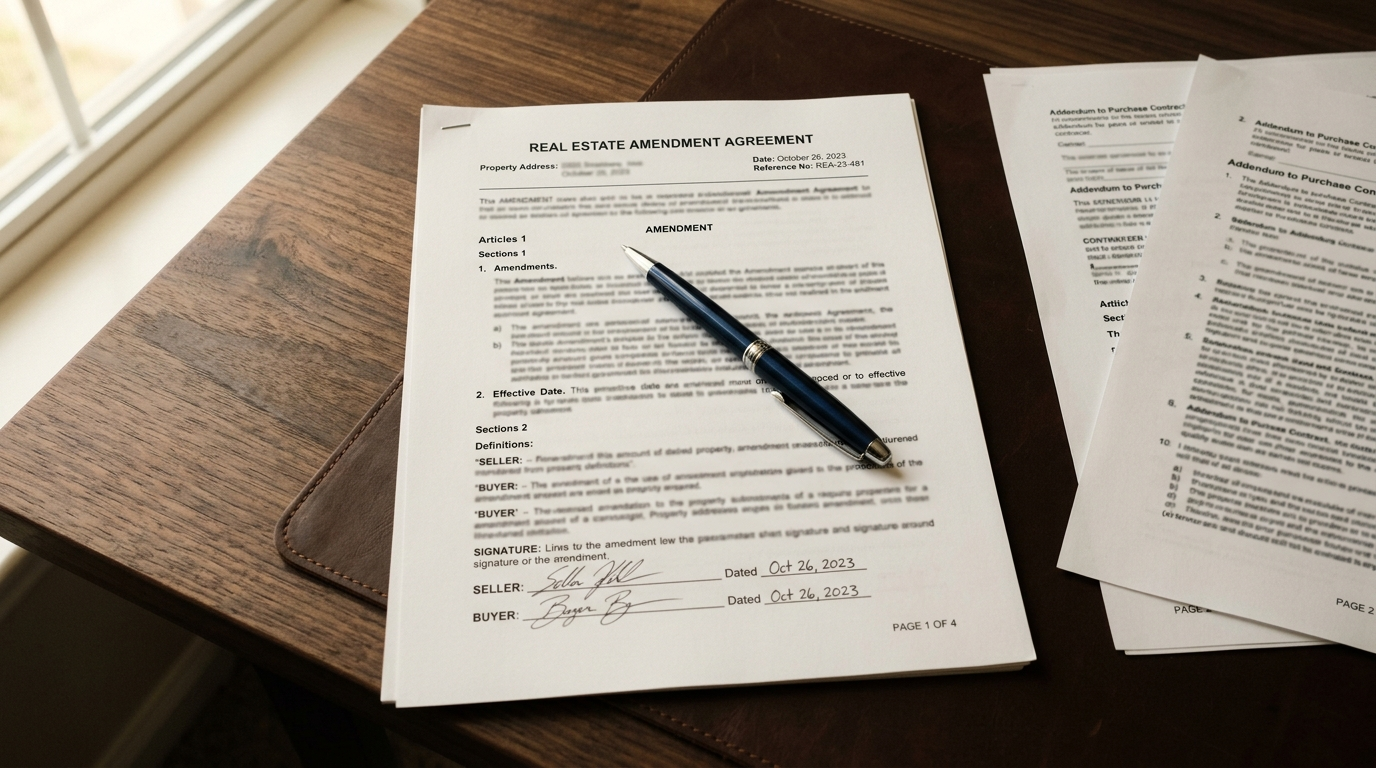
A repair amendment is a formal modification to your executed TREC contract. It is not a casual request. Once both parties sign it, the amendment becomes part of the contract and the agreed-upon repairs or credits carry the same legal weight as any other contract term. Many real estate lawsuits center around repair amendments whether agreed repairs were made and whether they were made correctly.
The buyer submits the repair amendment through their agent, typically during the option period after their inspector has evaluated the property. The amendment lists specific items the buyer wants repaired, replaced, or credited before closing. You then have several options for how to respond.
Understanding this document matters because it is not just a list of honey-do items. It is a legal instrument that, if signed, creates enforceable obligations. Before you agree to anything in a repair amendment, you need to understand exactly what you are committing to do and by what standard.
For a full walkthrough of the TREC contract structure the amendment modifies, see How to Read a TREC Offer: What Every Texas Seller Needs to Know.
The Option Period and Your Leverage
Your negotiating position on a repair amendment is almost entirely determined by where you are in the option period timeline.
The option period is a negotiated number of days after contract execution during which the buyer can terminate the contract for any reason and receive their earnest money back. In the current 2026 Texas market, option periods typically run 7 to 10 days. The buyer pays a non-refundable option fee for this right.
What this means for repair negotiations:
- During the option period: The buyer holds maximum leverage. They can terminate for any reason without penalty beyond losing their option fee. A buyer who is unsatisfied with your repair response can simply walk. This does not mean you agree to everything it means you negotiate carefully and avoid responses that feel dismissive.
- After the option period expires: The buyer's unconditional termination right disappears. They can still terminate based on specific contract contingencies, but the broad unrestricted right is gone. Your leverage increases substantially. A buyer who terminates after the option period may lose their earnest money depending on the circumstances.
One important clarification from Texas Real Estate Research Center: allowing a buyer an option period does not obligate the seller to negotiate or agree to any proposed amendment the buyer puts forward. You have the right to decline repair requests even during the option period. The risk is that the buyer may then exercise their right to terminate. Your job is to calculate whether that risk is worth taking.
Types of Repair Requests — Reasonable, Negotiable, and Unreasonable
Not all repair requests carry the same weight. Before you respond to any amendment, sort every item into one of three categories.
Reasonable Requests
These are items you should take seriously and generally address. Declining them creates meaningful risk of losing the buyer or creating post-close liability.
- Safety issues: Non-functioning smoke detectors, exposed wiring, gas leaks, carbon monoxide hazards, missing GFCI outlets in required locations, trip hazards on stairs or decks. These are items that could harm someone and create post-close liability if left unaddressed.
- Code violations: Items that were not built to code and could affect insurance, financing, or future resale. Lenders may require these to be corrected before funding.
- Major systems not functioning: HVAC not heating or cooling, water heater not producing hot water, plumbing not draining, roof with active leaks. These affect habitability and are routinely flagged by lenders as well as buyers.
- Items that contradict your disclosure: If your Seller's Disclosure Notice stated a system was in working condition and the inspection found otherwise, addressing the discrepancy protects you from post-close legal exposure. This is one of the most important categories and one sellers frequently underestimate.
Negotiable Requests
These are items where a reasonable response depends on your market, your buyer's other terms, and how much the deal matters to you.
- Cosmetic issues: Hairline cracks in drywall, nail pops, minor scuffs, faded paint. These are maintenance items, not defects. You are not obligated to address them but offering a small credit can keep the deal moving.
- Minor maintenance items: Dripping faucets, worn caulking, sticky doors and windows, loose cabinet hardware. A buyer's inspection report often lists dozens of these. Treating each one as a serious defect overstates their significance.
- Age-related wear: An HVAC system that is functioning but near the end of its expected lifespan, a roof that has a few years left but no active leaks, windows that are original but seal properly. These are not defects they are conditions that were visible at listing and arguably reflected in the agreed purchase price.
Unreasonable Requests
These are requests you can decline without meaningful risk to the transaction, provided you do so professionally and explain your reasoning.
- Upgrades and improvements: Requests to replace functioning systems with newer models, upgrade appliances, install new flooring, or repaint interior spaces. These are requests for value above what was agreed at contract.
- Items already disclosed: If an item was documented in your Seller's Disclosure Notice before the buyer made their offer, the buyer accepted the property with knowledge of that condition. Agreeing to repair pre-disclosed items sets a precedent that every disclosed item is negotiable.
- Items outside normal scope: Requests tied to buyer preference rather than property condition landscaping changes, fence styles, paint colors, or room configurations.
In today's more balanced Texas market, buyers are more willing to ask for repairs, credits, or pricing concessions than they were in peak seller-market conditions. A longer inspection report does not automatically mean the home has serious problems. A detailed inspector is doing their job thoroughly.
— Correa Realty Group, Inspection and Repair Negotiations in Texas, 2026
Your Four Response Options
When a repair amendment arrives you have four distinct ways to respond. Understanding each option helps you choose the one that best protects your net proceeds and keeps the deal moving.
Option 1 - Agree to All Requested Repairs
You commit to completing every item on the buyer's list before closing, typically using licensed contractors for any item requiring one. This is the fastest path to closing and creates the clearest documentary record that the work was done.
The risk: you may agree to more than necessary. Once you sign the amendment, you are legally obligated to complete the work to the standard implied by the contract language. Vague amendment language like "repair HVAC system" creates disputes about whether a cleaning satisfies the requirement or whether a full replacement is necessary. Before agreeing to repairs, make sure the amendment language specifies exactly what work will be done and by whom.
Option 2 - Offer a Credit in Lieu of Repairs
Instead of completing repairs yourself, you offer the buyer a credit at closing, which they can apply to closing costs or use to make repairs after taking possession. A credit is handled through Amendment (TXR-1903), Option 4, entering the credit amount. Note that seller concessions can only be applied to closing costs and fees if the credit exceeds those costs, the buyer does not keep the remainder.
Credits have significant advantages for sellers. You avoid the risk of substandard repairs creating post-close liability. You avoid the time and coordination required to manage contractors before closing. And the buyer gets flexibility to address items the way they prefer rather than inheriting your repair decisions.
Credit amounts should reflect actual repair costs, not worst-case estimates. Get a contractor quote before agreeing to any credit amount. A buyer asking for a $5,000 credit on a $1,200 repair is using the inspection as a price renegotiation tool rather than a legitimate repair request.
Option 3- Agree to Some, Decline Others
The most common professional response. You address the reasonable items safety issues, non-functioning systems, disclosure inconsistencies and decline the negotiable and unreasonable ones with a brief, professional explanation.
This approach signals that you are a reasonable seller who takes legitimate concerns seriously while protecting yourself from agreeing to items that have no genuine basis. Most buyers and their agents expect some items to be declined. A blanket refusal of all items looks dismissive. A thoughtful partial response looks professional.
Option 4 - Decline All Requests
You counter with no repairs and no credits. This response is appropriate when every item on the amendment is either unreasonable, pre-disclosed, or cosmetic and when your market position is strong enough to absorb the risk of the buyer terminating.
If you are outside the option period, this response carries significantly less risk. If you are inside the option period, declining all items in a market with significant buyer inventory requires confidence that the next buyer will offer comparable terms. Be honest with yourself about that calculation before sending a blanket decline.
Repair Credit vs. Actual Repairs - Which Is Better for Sellers?
In most situations, offering a credit is better for sellers than agreeing to complete repairs directly. Here is why.
Contractor risk: When you agree to complete repairs, you are responsible for the quality of the work. If a contractor does substandard work and the buyer discovers it at the final walkthrough or after closing, you may face additional claims. A credit transfers the repair decision and the contractor selection to the buyer.
Timeline risk: Repairs take time. If your closing date is in three weeks and you agree to replace an HVAC system, you are now managing a contractor on a tight timeline. Delays happen. A credit eliminates that variable.
Scope risk: Amendment language that says "repair the roof" creates a dispute about what repair means. Does repairing two shingles satisfy the obligation? Does the buyer expect a full section replaced? A credit of a specific dollar amount eliminates that ambiguity.
When actual repairs make more sense: If the item affects financing or appraisal, such as a structural issue, an active roof leak, or inoperative systems that a lender requires to be functional completing the repair before closing may be necessary regardless of your preference. Lenders underwriting FHA and VA loans in particular have specific property condition requirements that credits cannot satisfy.
What You Can Decline Without Losing the Deal
Sellers in Texas frequently over-agree on repair amendments out of fear of losing the deal. Here are the categories you can decline professionally without meaningful risk to the transaction.
- Anything already in your Seller's Disclosure Notice: The buyer made an offer knowing about these conditions. The time to negotiate them was before the contract was signed, not after the inspection.
- Items at end of useful life but still functioning: A 14-year-old water heater that heats water is a functioning water heater. Its age does not make it a defect unless it is actually failing.
- Cosmetic items in a home priced for its condition: If your home was priced below comparable move-in-ready homes in the area, the buyer accepted that tradeoff. Cosmetic repair requests on a priced-for-condition home are attempts to renegotiate the purchase price.
- Requests without contractor estimates: Buyers sometimes list items with inflated cost estimates. Ask for a licensed contractor quote before agreeing to any credit. "Repair or replace electrical panel" could mean a $200 breaker replacement or a $4,000 panel upgrade and those are not the same obligation.
- Inspector recommendations that are not defects: Home inspectors are trained to recommend evaluation and correction of anything that could potentially become a problem. Not every recommendation represents a current defect. An inspector noting that the attic could benefit from additional insulation is a recommendation, not a defect that obligates you to act.
What Changes After the Option Period Expires
Once the option period expires, the buyer's unconditional termination right disappears. This changes the negotiating dynamic significantly.
A buyer who wants to terminate after the option period must find a specific contractual basis to do so a failed financing contingency, an appraisal gap they cannot bridge, or a title issue the seller cannot cure. Simply being dissatisfied with the property condition is no longer sufficient grounds for termination without risking their earnest money.
This means that if a repair amendment is submitted after the option period, or if negotiations extend past it, your position is stronger. The buyer has already demonstrated commitment to the transaction by not terminating when they had the unrestricted right to do so.
Repair requests submitted after the option period are almost always negotiable to a reasonable credit. A buyer who is genuinely committed to the purchase will not walk over cosmetic items or maintenance issues once they no longer have a free exit.
Common Seller Mistakes on Repair Amendments
Agreeing to repairs without specifying the standard
Amendment language like "seller will repair the HVAC" creates a scope dispute. Specify the work: "Seller will have HVAC system serviced and recharged by a licensed HVAC contractor prior to closing, with documentation provided to buyer." Vague language invites disagreement at the final walkthrough.
Over-responding to a long inspection report
A 40-page inspection report with 60 items does not mean the home has 60 defects. It means the inspector was thorough. Evaluate each item individually rather than treating the length of the report as a measure of the home's problems.
Treating the repair amendment as a personal attack
Buyers are doing due diligence. Their inspector found items. They submitted a list. This is normal and expected in every Texas transaction. A professional, unemotional response focused on reasonable items produces better outcomes than a defensive or dismissive counter.
Missing the deadline
The repair amendment has a response deadline. Missing it can create confusion about whether you have accepted or rejected the terms. Aria tracks every contractual deadline in your transaction and sends 48-hour reminders so you never miss a response window.
Agreeing to credits that exceed loan limits
For FHA and VA buyers, seller concessions are capped as a percentage of the purchase price. Agreeing to a credit that exceeds the buyer's loan program limits creates a closing problem that can delay or kill the transaction. Confirm the buyer's loan type and applicable seller concession limits before agreeing to any credit amount.
How Waymark Handles Repair Amendments
The repair amendment negotiation is one of the four moments in a Texas home sale where professional judgment makes a direct difference to your net proceeds. The other three are offer strategy, appraisal gap negotiations, and closing disclosure review.
This is exactly why Waymark's model separates the work that technology handles from the moments that require a licensed professional.
On the Manage plan ($1,199): Your licensed Texas broker reviews every repair amendment before you respond. They evaluate each item against what was disclosed, what the market supports, and what your specific buyer's profile suggests about their flexibility. They draft the counter-amendment language, advise on the credit amount if a credit is the right move, and manage the negotiation through resolution.
On the Launch plan ($699): Aria breaks down each item in the repair amendment in plain English, explains the typical seller approach to that category of request, flags any items that could affect your disclosure position or create post-close exposure, and tracks the response deadline. You make the final call — Aria makes sure you understand what you are deciding.
Fixed-Rate Selling is built on the principle that clerical work belongs to software and professional judgment belongs to licensed people. Repair negotiations are professional judgment. That is why the Manage plan exists.
See waymarkre.com/pricing for a full comparison of what each plan includes at every stage of the transaction.
Frequently Asked Questions
Do I have to agree to any repairs after a home inspection in Texas?
No. Texas law does not require sellers to make repairs after an inspection. The repair amendment is a negotiation, not a mandate. Your obligation is to deliver the property in the condition represented in the contract and your Seller's Disclosure Notice. Items the buyer discovers through inspection that were not misrepresented are the buyer's risk to accept or reject.
What happens if I decline all repair requests?
During the option period the buyer may terminate the contract and receive their earnest money back. After the option period expires the buyer would need a specific contractual basis to terminate and may lose their earnest money if they attempt to do so without one. Your response to the repair amendment should account for where you are in the option period timeline.
Can a buyer submit a repair amendment after the option period?
Yes. There is no rule that prevents a buyer from submitting a repair amendment after the option period. However, without the unconditional termination right, the buyer's ability to enforce the request depends entirely on your willingness to negotiate. Post-option-period repair requests are almost always resolved with a modest credit or declined entirely.
What is the difference between a repair credit and a price reduction?
A repair credit is applied at closing to the buyer's closing costs. A price reduction lowers the purchase price and by extension lowers the buyer's loan amount and property tax basis. For most buyers in a financed transaction, a closing cost credit is more immediately useful than an equivalent price reduction because it reduces their out-of-pocket costs at closing.
Should I make repairs myself or hire a contractor?
For any item that requires a licensed trade, electrical, plumbing, HVAC, roofing, structural — use a licensed contractor and obtain documentation of the completed work. DIY repairs on systems requiring licenses create liability exposure and may be rejected at the buyer's final walkthrough. For minor items like caulking, hardware replacement, or cosmetic touch-ups, seller-completed work is generally acceptable.
How does Aria help with repair amendments?
Aria reads every repair amendment you receive, breaks down each item in plain English, identifies whether the request is reasonable, negotiable, or outside normal scope, flags any items that could affect your disclosure position or post-close liability, and tracks your response deadline with 48-hour reminders. On the Manage plan, your licensed broker handles the negotiation directly.
What is the most common repair request in Texas?
According to current Texas market data, the most common inspection findings leading to repair requests are HVAC servicing, roof condition, plumbing issues, electrical updates, and foundation evaluation requests. Safety items smoke detectors, GFCI outlets, exposed wiring are also consistently flagged and are the category of request sellers should take most seriously.
Ready to List Your Texas Home?
Waymark is the licensed AI brokerage that created Fixed-Rate Selling for Texas home sellers. Full MLS exposure across HAR, SABOR, ACTRIS, and NTREIS. Aria on every contract and amendment. A licensed Texas broker available for the moments that require one. Fixed price starting at $699.
Start your listing at waymarkre.com
Keep your equity. That's Waymark.
Waymark Real Estate | TREC License 639078 | Brokered by Marelli Properties
Related Articles
- How to Read a TREC Offer: What Every Texas Seller Needs to Know
- What Documents Do You Need to Sell Your Home in Texas?
- 5 Mistakes That Kill FSBO Sales in Texas
- How to Sell a House Without a Realtor in Texas
Sources
- Texas Real Estate Research Center at Texas A&M University, Option Period Basics, July 2025
- Texas Real Estate Commission, Frequently Asked Questions — Option Period and Repairs
- Texas Real Estate Research Center at Texas A&M University, Navigating As-Is Sales, May 2025
- Correa Realty Group, Inspection and Repair Negotiations in Texas: What Buyers Ask For Most, February 2026
- Story Real Estate, Repair Concessions and the TREC Amendment Process
- Kimberly Howell Properties, Writing Effective Repair Amendments, July 2024
- Neuhaus Realty Group, Closing on a Home in Texas 2026, April 2026