When you are selling a home in Texas, completing the Texas Seller's Disclosure Notice is a critical step in residential real estate disclosure. Understanding Texas Property Code 5.008 and following best practices is essential for avoiding real estate lawsuits later on.
The Texas Seller's Disclosure Notice is the most important document you will fill out when selling your home. It is also the one most sellers rush through without understanding what they are signing.
The form has 13 sections and over 100 individual items covering everything from foundation history to environmental hazards to whether your property has ever flooded. Every answer you give creates a legal representation about your home's condition. Get it wrong, and a buyer can sue you after closing for misrepresentation under the Texas Deceptive Trade Practices Act (DTPA), with damages that can be tripled in cases of knowing fraud (Texas Property Code Section 5.008).
This guide walks you through what the form requires, what each section covers, the most dangerous mistakes sellers make, and how to protect yourself.
- What Is the Texas Seller's Disclosure?
- Who Is Required to Provide One?
- Who Is Exempt?
- What "To the Best of Seller's Knowledge" Actually Means
- TREC OP-H vs. TAR TXR-1406: Which Form to Use
- What Each of the 13 Sections Covers
- The 7 Highest-Risk Items on the Disclosure
- 8 Mistakes That Lead to Lawsuits
- "Unknown" Is Not a Get-Out-of-Jail Card
- "As-Is" Does Not Replace the Disclosure
- When to Deliver the Disclosure
- Your Duty to Update After Signing
- How Waymark Handles the Disclosure
- Frequently Asked Questions
What Is the Texas Seller's Disclosure?
The Texas Seller's Disclosure Notice is a written statement required by Texas Property Code Section 5.008. It requires sellers of residential property (one dwelling unit) to document the condition of the property based on what they know at the time they sign the form.
The form is not a warranty. It is not a guarantee that everything works. It is a snapshot of what you know, or should know, about your home on the date you complete it. The statute says the notice must be completed "to the best of seller's belief and knowledge as of the date the notice is completed and signed by the seller" (FindLaw, Texas Property Code 5.008).
If that sounds like simple paperwork, consider this: disclosure disputes are one of the leading categories of residential real estate litigation in Texas. Buyers who discover undisclosed defects after closing can sue for actual damages, consequential damages, attorney fees, and in cases of knowing fraud, treble damages under the DTPA (Houston Business Lawyers).
Who Is Required to Provide One?
If you are selling a single-family home, townhouse, condo, or one side of a duplex in Texas, you are required to provide a Seller's Disclosure Notice to the buyer. This applies whether you are selling with a traditional agent, through a flat fee MLS service, or entirely on your own as a FSBO seller. The method you use to sell does not change the disclosure requirement. Texas Property Code Section 5.008 applies to the seller, not the agent (HomeRise, 2026).
Who Is Exempt?
Texas Property Code Section 5.008(e) lists specific exemptions. If any of the following apply, you are not required to provide the standard disclosure form:
- Transfers between co-owners
- Transfers to a spouse or direct lineal descendant (parent, child, grandparent, grandchild)
- Transfers between spouses as part of a divorce
- Transfers under a court order, including probate sales
- Foreclosure sales, deeds in lieu of foreclosure, or trustee sales
- Transfers from an executor or administrator directly to the estate's heirs
- New construction that has never been occupied
- Transfers of property that was never occupied as a residence by the seller
Two important notes. First, selling "as-is" is not an exemption. A seller who lists a home as-is is still required to complete and deliver the disclosure. The as-is clause limits the seller's duty to repair, not the duty to disclose (Neuhaus Realty, 2026). Second, even exempt sellers can still be held liable for intentional fraud or concealment of known defects. The exemption removes the statutory obligation to provide the form. It does not create a license to lie.
What "To the Best of Seller's Knowledge" Actually Means
The disclosure asks what you know. It does not ask you to test for anything, hire an inspector, or investigate conditions you are not aware of. If you genuinely do not know the answer to a question, "Unknown" is an available option and using it satisfies the legal requirement.
But there is a critical distinction. "Unknown" means you genuinely have no knowledge. It does not mean you would prefer not to answer. A seller who marks "Unknown" on whether the roof has ever leaked, when there are visible water stains on the ceiling from a leak the seller witnessed, is making a false representation. Courts and juries can evaluate whether "Unknown" was plausible given the circumstances (Texas Real Estate Research Center, 2026).
The form also does not require you to disclose certain stigmatizing information. Under Section 5.008(c), you have no duty to disclose deaths on the property from natural causes, suicide, or accidents unrelated to the property's condition, or whether a previous occupant had or may have had HIV or AIDS.
TREC OP-H vs. TAR TXR-1406: Which Form to Use
Two versions of the disclosure form are commonly used in Texas:
TREC Form OP-H is the standard form published by the Texas Real Estate Commission. It satisfies the minimum requirements of Section 5.008 and is available as a free download from trec.texas.gov. This form is most commonly used in FSBO sales.
TAR TXR-1406 is the more detailed version published by the Texas Association of Realtors. It covers the same statutory requirements but includes additional questions and more specific sub-items. This is the form used in most agent-assisted transactions and by Waymark.
The TAR form is more thorough. It has 13 sections and over 100 individual items, compared to the TREC form which covers the same general categories with fewer sub-items. Using the more detailed form is not required, but it provides more complete documentation and may reduce post-closing disputes because it forces the seller to address more specific conditions.
What Each of the 13 Sections Covers
Here is a plain-English overview of every section on the TAR TXR-1406 form. This is the form Waymark uses and the one most commonly encountered in Texas transactions.
Section 1: Property Items. An inventory of what is in your home. Appliances, systems, and features: pool, hot tub, smoke detectors, security system, sprinkler system, ceiling fans, garage door openers, water heater, disposal, range, microwave, dishwasher, and more. You mark Yes, No, or Unknown for each item. This section also asks whether each item is in working condition.
Section 2: Roof. Type of roof, age, whether it has ever leaked, and whether repairs have been made. Roof history is one of the most scrutinized sections because it directly affects the buyer's insurance options in Texas, particularly in hail-prone markets like San Antonio, Austin, and DFW.
Section 3: Water Supply and Sewer. Whether the property is on city water or a private well, city sewer or septic system. If on well or septic, the disclosure requires significantly more detail about condition, permits, and maintenance history. Hill Country properties around Austin and San Antonio frequently require additional disclosures for wells and septic.
Section 4: Structural. Foundation type, history of movement or cracking, previous repairs, and any known structural concerns. This is one of the highest-risk sections. Foundation issues are common in Texas due to expansive clay soils, particularly in San Antonio, Dallas-Fort Worth, and Houston. Buyers and their inspectors examine this section carefully.
Section 5: Systems and Equipment. HVAC, plumbing, electrical, and appliance systems. Age, condition, known defects, and maintenance history. If the HVAC was replaced, the seller should know the approximate year and whether it was permitted.
Section 6: Additional Structural. Walls, ceilings, floors, doors, windows, and other structural components. Known defects, water damage, termite history, and previous repairs. Water intrusion and termite damage are common triggers for post-closing disputes.
Section 7: Soil and Drainage. Grading, drainage patterns, erosion, and flooding. Texas added enhanced flood disclosure requirements after Hurricane Harvey. Sellers must disclose whether the property is in a FEMA-designated 100-year or 500-year floodplain, whether it has flooded in the past five years, whether it has ever been repaired for flood damage, and whether the seller has ever received flood insurance proceeds (Houston Business Lawyers).
Section 8: Environmental Hazards. Lead-based paint (required for all pre-1978 homes under federal law), asbestos, radon, underground storage tanks, and contamination. This section also covers CSST (corrugated stainless steel tubing) gas piping, which Texas added as a disclosure requirement effective September 2023 under HB 697, following the death of 15-year-old Brennen Teel from a lightning-related CSST gas leak.
Section 9: Insurance Claims. Previous insurance claims filed on the property. This is one of the most commonly missed items. Buyers can discover prior claims through CLUE (Comprehensive Loss Underwriting Exchange) reports even if the seller does not disclose them. A hail claim from three years ago, a water damage claim, or a theft claim all show up. Failing to disclose a claim that is discoverable through a CLUE report is one of the most common sources of post-closing disputes.
Section 10: HOA and Deed Restrictions. Whether the property is in an HOA, the name and contact information for the HOA, monthly or annual fees, and any known deed restrictions. If the HOA has special assessments pending, this is where they are disclosed.
Section 11: Legal Issues. Boundary disputes, easements, encroachments, liens, and pending litigation. If a neighbor's fence is on your property or your driveway extends onto theirs, this is where it goes. If there are utility easements that affect what can be built on the lot, they are disclosed here. This section connects directly to the property survey.
Section 12: Utilities. Utility providers for electric, gas, water, sewer, and trash. This section is straightforward but varies by market. Waymark auto-fills utility providers based on property location: CPS Energy and SAWS in San Antonio, CenterPoint Energy in Houston, Austin Energy and Austin Water in Austin, and Oncor and Atmos Energy in DFW.
Section 13: Additional Information. Anything not covered in the previous 12 sections. This is the catch-all where sellers disclose unusual conditions, planned construction nearby that may affect value, noise issues, or other material facts that a buyer should know about.
The 7 Highest-Risk Items on the Disclosure
Not every item on the disclosure carries the same legal weight. These seven items are the ones most likely to generate post-closing disputes, lawsuits, or buyer termination:
1. Foundation history. Any previous foundation repair, movement, cracking, or engineering reports. This is the number one source of disclosure disputes in Texas due to the prevalence of expansive clay soils.
2. Flooding history. Whether the property has ever flooded, is in a floodplain, or has received flood insurance proceeds. After Hurricane Harvey, Texas enhanced these disclosure requirements significantly.
3. Roof condition and age. Whether the roof has leaked, been repaired, or been replaced. In hail-prone Texas markets, roof history directly affects buyer insurance eligibility and premiums.
4. Previous insurance claims. Any claim filed on the property, regardless of outcome. CLUE reports make these discoverable even if the seller does not disclose them.
5. Water intrusion or damage. Any history of water entering the home through walls, windows, foundation, or roof. Water damage can indicate mold risk, which is a common basis for DTPA claims.
6. CSST gas piping. Whether the home has corrugated stainless steel tubing for gas lines. Required to be disclosed since September 2023 under HB 697.
7. Unpermitted work. Any additions, conversions, or modifications completed without building permits. A converted garage, an enclosed patio, or an added bathroom without permits must be disclosed even if the work was done by a previous owner and the seller did not do it, as long as the seller is aware of it.
8 Mistakes That Lead to Lawsuits
1. Answering "Unknown" to avoid a difficult question. If you know the answer, "Unknown" is a misrepresentation. Buyers' attorneys look for this pattern, especially on items where the seller clearly should have knowledge.
2. Forgetting previous insurance claims. That 2021 hail claim on the roof is discoverable through CLUE reports. Disclose it. A buyer who discovers it after closing has grounds for a claim.
3. Omitting unpermitted work. The garage conversion, the enclosed patio, the added bathroom without a permit. These must be disclosed, even if the work was done before you bought the home, as long as you are aware of it.
4. Being inconsistent between sections. Marking "No" to foundation problems in Section 4 but disclosing foundation repair receipts in Section 13 creates a conflict that buyers and their attorneys will question.
5. Not disclosing repaired conditions. A common misconception is that if a problem was fixed, it does not need to be disclosed. This is generally not true. The disclosure asks about history, not just current condition. A foundation that was repaired is still a foundation that had a problem.
6. Not having the disclosure in the MLS before showings. If the disclosure is not available when an offer is written, the buyer's agent selects the paragraph in the TREC contract that requires the seller to deliver it within a specified number of days (usually 1 to 3). If the seller does not deliver by 5pm on the deadline day, the buyer can terminate at any time and get their earnest money back. Having the disclosure in the MLS before the first showing eliminates this risk entirely.
7. Not updating the disclosure after signing. If something changes between signing the disclosure and closing (the water heater fails, a leak appears, termites are found), you have a duty to update the form. The disclosure is a living document through closing.
8. Assuming "as-is" covers you. It does not. The Texas Supreme Court held in Prudential Insurance Co. of America v. Jefferson Associates that an "as-is" clause can be voided if the seller actively concealed a known defect (Neuhaus Realty, 2026).
"Unknown" Is Not a Get-Out-of-Jail Card
Marking "Unknown" is legitimate when you genuinely do not know the answer. If you bought the home two years ago and have never had the foundation inspected, marking "Unknown" on whether there is foundation movement is reasonable. You have no basis for knowledge.
But "Unknown" becomes a problem when the seller clearly should know. A seller who marks "Unknown" on whether the roof has leaked, when water stains are visible on the bedroom ceiling, will not find a sympathetic jury. The standard is "to the best of seller's belief and knowledge." Courts look at whether the seller's claimed lack of knowledge is plausible given the circumstances.
The safest approach: answer honestly. If you know, say so. If you do not know, say "Unknown" and feel comfortable with that answer. If you are tempted to mark "Unknown" because the truthful answer is uncomfortable, that is the moment to consult a broker or attorney.
"As-Is" Does Not Replace the Disclosure
One of the most common and most dangerous misconceptions in Texas real estate is that selling a home "as-is" eliminates the duty to disclose. It does not.
Selling as-is means the seller is not obligated to make repairs. It does not mean the seller is not obligated to tell the buyer what is wrong. The as-is clause limits the duty to repair. The disclosure requirement limits the duty to conceal. They are separate legal obligations.
If a seller knows the foundation has problems and sells the home as-is without disclosing the foundation issues, the seller is exposed to fraud claims, DTPA claims, and potentially treble damages, regardless of the as-is language in the contract.
When to Deliver the Disclosure
The best practice is simple: complete the disclosure before you list and upload it to the MLS. When the disclosure is already available in the MLS, the buyer's agent has access to it before writing an offer. On the TREC 1-4 Residential Contract (Paragraph 7B), the buyer's agent checks the box confirming "Buyer has received the Seller's Disclosure Notice." That is the cleanest scenario for the seller (Texas Realtors).
If the disclosure is not available when the offer is written, the buyer's agent selects the second option in Paragraph 7B(2) and fills in a number of days the seller has to deliver it after the effective date of the contract. This is typically 1 to 3 days. Here is where it becomes a problem for the seller:
If the seller does not deliver the disclosure by 5pm on the deadline day, the buyer can terminate the contract at any time before closing and is entitled to a full refund of their earnest money. There is no cure period. The buyer does not need to give a reason. They can simply walk away.
This is why having the disclosure in the MLS before the first showing is so important. When a buyer's agent writes an offer and checks "disclosure received," the seller has eliminated the single easiest exit ramp a buyer can use to walk away from the deal. When the second box is checked and a day count is filled in, the seller is handing the buyer a free termination window that did not need to exist.
Your Duty to Update After Signing
The disclosure is not a one-time document. Your duty to disclose known conditions runs through closing. If something changes between the time you sign the disclosure and the day the property closes, you has a legal obligation to update the form.
Examples: the water heater fails, a pipe bursts, you discover termites, the HVAC stops working, a storm damages the roof. All of these require an amended disclosure delivered to the buyer. Failing to update is treated the same as failing to disclose in the first place.
How Waymark Handles the Disclosure
Waymark built the most comprehensive seller's disclosure guidance in the Texas market because we believe this is the highest-risk step in the selling process and the one where sellers get the least help.
On both the Launch ($699) and Manage ($1,199) plans, Aria walks you through every one of the 13 sections and over 100 individual items on the TAR TXR-1406 form. For each item, Aria provides a plain-English explanation of what the question is asking, why it matters, and what sellers in similar situations typically consider. Every section introduction reminds you that how you answer is your decision based on your own knowledge.
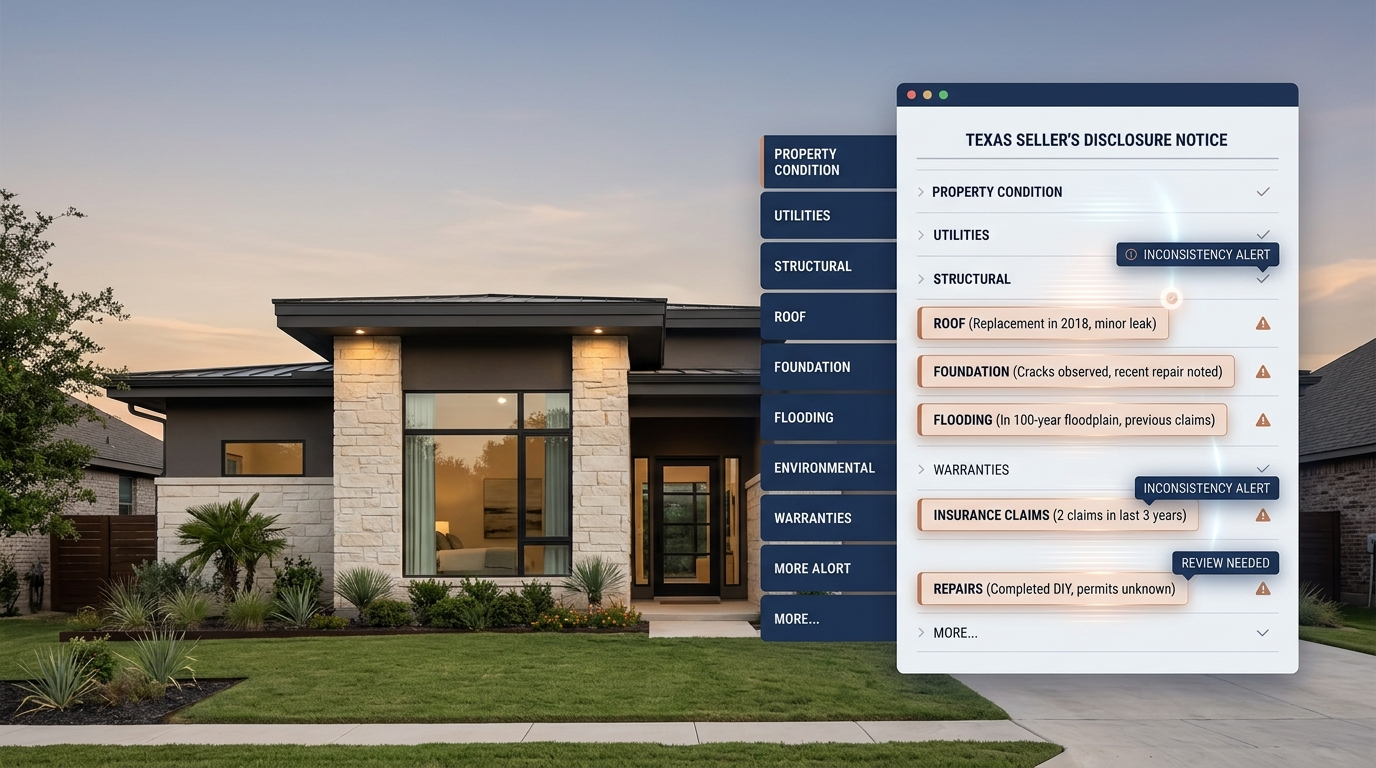
Aria also runs inconsistency detection. If your answers in one section conflict with answers in another section, Aria flags the inconsistency and explains why a buyer or their agent might question it. You decide whether to change anything. Aria does not tell you how to answer. Aria makes sure you understand what you are answering.
On the Manage plan ($1,199), a licensed broker reviews the completed disclosure before it is shared with any buyer. The broker looks for missing information, inconsistencies, and items that might need additional detail. If they have questions, they reach out before the form goes live.
Because the disclosure is completed during the pre-listing setup, it is ready to upload to the MLS before your home goes on the market. That means every buyer's agent who writes an offer can check "disclosure received" on the TREC contract, eliminating the termination window that comes with late delivery. This is one of the most important tactical advantages of completing the disclosure early and thoroughly.
No other flat fee MLS service in Texas provides this level of disclosure guidance. Most listing services upload the form and move on. Waymark treats the disclosure as one of the four most important milestones in the transaction, alongside pricing, offer review, and closing disclosure review.
See Waymark pricing | Compare your options
Frequently Asked Questions
Is a seller's disclosure required in Texas?
Yes. Texas Property Code Section 5.008 requires sellers of residential property (one dwelling unit) to provide a written Seller's Disclosure Notice to the buyer. This applies whether you use an agent, a flat fee service, or sell FSBO. Specific exemptions exist for foreclosures, court-ordered transfers, new construction, and family transfers.
What happens if I do not provide a disclosure?
If the disclosure is not in the MLS when the offer is written, the buyer's agent fills in a number of days for you to deliver it (usually 1 to 3). If you miss that deadline, the buyer can terminate at any time before closing and get their earnest money back. If you never provide one and a defect is discovered after closing, you are exposed to lawsuits under the DTPA, common-law fraud, and negligent misrepresentation, with damages that can include treble damages and attorney fees.
Can I sell my home "as-is" without a disclosure?
No. Selling as-is limits your duty to repair, not your duty to disclose. You must still complete and deliver the Seller's Disclosure Notice. The Texas Supreme Court has held that an as-is clause can be voided if the seller actively concealed known defects.
What if I truly do not know the answer to a question?
Mark "Unknown." This is a legitimate answer when you genuinely have no knowledge of the condition. The statute explicitly states that marking something as unknown, when the information is genuinely unknown to the seller, satisfies the legal requirement. However, marking "Unknown" on items where you clearly should have knowledge can be treated as misrepresentation.
Do I have to disclose previous repairs?
Generally, yes. The disclosure asks about the history and condition of property systems and components. A foundation that was repaired, a roof that was replaced after a leak, or plumbing that was re-routed after a problem should all be disclosed. Repairs correct defects, but the history of the defect is still part of the property's condition.
Does the seller's disclosure cover HOA issues?
Yes. Section 10 of the form covers HOA information including the name and contact of the association, fees, special assessments, and deed restrictions. If there are pending special assessments or HOA disputes, those should be disclosed.
What is CSST and do I have to disclose it?
CSST stands for corrugated stainless steel tubing, a type of flexible gas piping. Texas requires disclosure of CSST since September 2023 under HB 697. The legislation was prompted by the death of Brennen Teel, a teenager killed when lightning struck near CSST piping that was not properly bonded. If your home has CSST gas lines, you are required to disclose it.
Do FSBO sellers have to provide a disclosure?
Yes. The disclosure requirement applies to the seller, not the agent. Whether you sell with a traditional agent, a flat fee MLS service, or entirely on your own, you must provide the same disclosure. The legal obligation is identical regardless of how you sell.
How does Waymark help with the disclosure?
Waymark's AI, Aria, walks you through every item on the TAR TXR-1406 form with plain-English explanations of what each question is asking and why it matters. Aria detects inconsistencies between sections and flags them before you submit. On the Manage plan, a licensed broker reviews the completed form before any buyer sees it. Learn about Fixed-Rate Selling.
Do Not Rush This Form
The seller's disclosure is not a box to check. It is a legal document that creates obligations that follow you after closing. Take your time. Answer honestly. If you are not sure about an item, use "Unknown" when it is genuine, and consult a broker or attorney when it is not.
The sellers who get into trouble are not the ones who disclose too much. They are the ones who disclose too little.
Waymark Real Estate | TREC License 639078 | Brokered by Marelli Properties
Related Articles
- How to Sell a House Without a Realtor in Texas
- Closing Without a Listing Agent: What to Expect
- How a CMA Prices Your Home
- What Closing Costs Does a Seller Pay in Texas?
- Best Flat Fee MLS Companies in Texas (2026)
Sources
- Texas Property Code Section 5.008, Justia
- Texas Real Estate Research Center, "The Checkbox That Could Change Everything," TRERC, April 2026
- Neuhaus Realty Group, "Seller Disclosures in Texas (2026)," neuhausre.com
- Houston Business Lawyers, "Texas Seller's Disclosure Notice: Requirements, Exemptions & Risks," houstonbusinesslawyers.net
- HomeRise, "Sellers Disclosure Texas: Free 2026 Guide," homerise.com
- LoneStarLandLaw, "Disclosure Obligations of Sellers and Their Brokers," lonestarlandlaw.com
- FindLaw, Texas Property Code Section 5.008, findlaw.com
- Mendlog, "Texas Home Seller Disclosure Requirements (2026 Update)," mendlog.com
- ListingResults, "Seller Disclosure & Do You Need to Fill Out," listingresults.com