I have spent 15 years in Texas real estate watching sellers hand over thousands of dollars at closing for work that, in most transactions, follows a predictable pattern. Price the home. Complete the disclosure. Get it on the MLS. Review offers. Navigate the inspection. Handle the appraisal. Get to closing. The process is the same every time. What changes is the judgment required at each step.
That observation is what led me to build Waymark. AI can handle the process. A licensed broker handles the judgment. Texas sellers should not have to pay 3% of their sale price to access both.
Most sellers think they have two choices. Pay a listing agent 3% of the sale price. On a $310,000 home in San Antonio that is $9,300 out of your equity before you see a dollar. Or use a flat fee MLS service for $99, get on Zillow, and handle everything that follows on your own. There is a third way, and it is what guided home selling looks like.
Why Selling Without a Listing Agent Is More Viable Than It Has Ever Been
Two things changed in the same period that made selling without a traditional listing agent genuinely practical for the first time.
The first was the 2024 NAR settlement, which ended the requirement that sellers offer a buyer's agent commission as a condition of listing on the MLS. Texas sellers now have full flexibility in how they structure their transaction costs. Verify current MLS rules for your specific board at trec.texas.gov.
The second was AI. Not AI in the abstract, but AI tools that became specifically capable of handling the analytical and administrative work that listing agents have traditionally performed: pricing research, disclosure guidance, offer analysis, contract translation, and deadline tracking.
Those two changes happened at the same time. The commission structure that bundled all of that work into a single relationship at a percentage of your sale price no longer reflects the actual cost of delivering it. AI is unbundling the traditional listing service. Waymark is built around that reality.
The Texas Seller's Disclosure: The Task Most Sellers Fear Most
In 15 years of working with Texas sellers, the Texas Seller's Disclosure Notice is the document that causes the most anxiety. Most sellers have never seen it before listing day. They open a form with 13 sections and over 100 individual items asking what they know about their property's condition and history, and they have no idea where to start.
The stakes are real. The disclosure is governed by Texas Property Code Section 5.008 and carries post-closing liability. A seller who answers incorrectly or incompletely because they did not understand what the form was asking can face legal exposure years after closing. TREC updates the form periodically, so always verify the current version at trec.texas.gov/forms before completing it.
This is where AI earns its place. Aria walks sellers through every section in plain English. Not the legal phrasing on the form, but what each question is actually asking and why it matters. The items sellers most commonly overlook: prior water intrusion even if repaired, foundation movement noted by any previous inspector, mold remediation affecting 25 or more contiguous square feet, and permit status of any improvements made during ownership.
On the Waymark Manage plan, a licensed broker reviews the completed disclosure before it goes to any buyer. That review catches the errors that create liability later. The entire process, guidance, completion, e-signature, and delivery, happens in one platform rather than the manual print-scan-sign-email path most FSBO sellers use.
What AI Actually Does Across the Full Transaction
The word AI gets used loosely in real estate marketing. Before you evaluate any platform that claims to use it, it is worth understanding what AI can actually do in a Texas transaction and where its limits are.
Aria, Waymark's AI system, handles six categories of work that listing agents have traditionally performed.
Pricing analysis. Aria builds a pricing analysis using comparable sales data for your area, adjusting for square footage, year built, lot size, condition, and school district. Texas is a non-disclosure state, which means sold prices are not publicly recorded in county deed records. Aria surfaces active listing data, county appraisal district values, and price-per-square-foot trends to build a defensible pricing range before your listing goes live.
Seller's Disclosure guidance. Covered in detail above. This is the most demonstrable thing Aria does and the most valuable for sellers who have never completed the form before.
Offer review and contract translation. When an offer arrives on the One to Four Family Residential Contract, Aria extracts every material term, calculates your estimated net proceeds, and flags anything that represents risk or requires attention. Option period length, option fee, earnest money amount, financing contingency, survey selection, closing date, and any special provisions. You see what the offer actually says in plain English before you respond.
Repair request analysis. After the inspection, Aria helps you evaluate which repair items are negotiable, which are standard, and what a reasonable response looks like based on what your contract requires. Sellers who understand the difference between what a buyer asks for and what they are entitled to negotiate from a much stronger position.
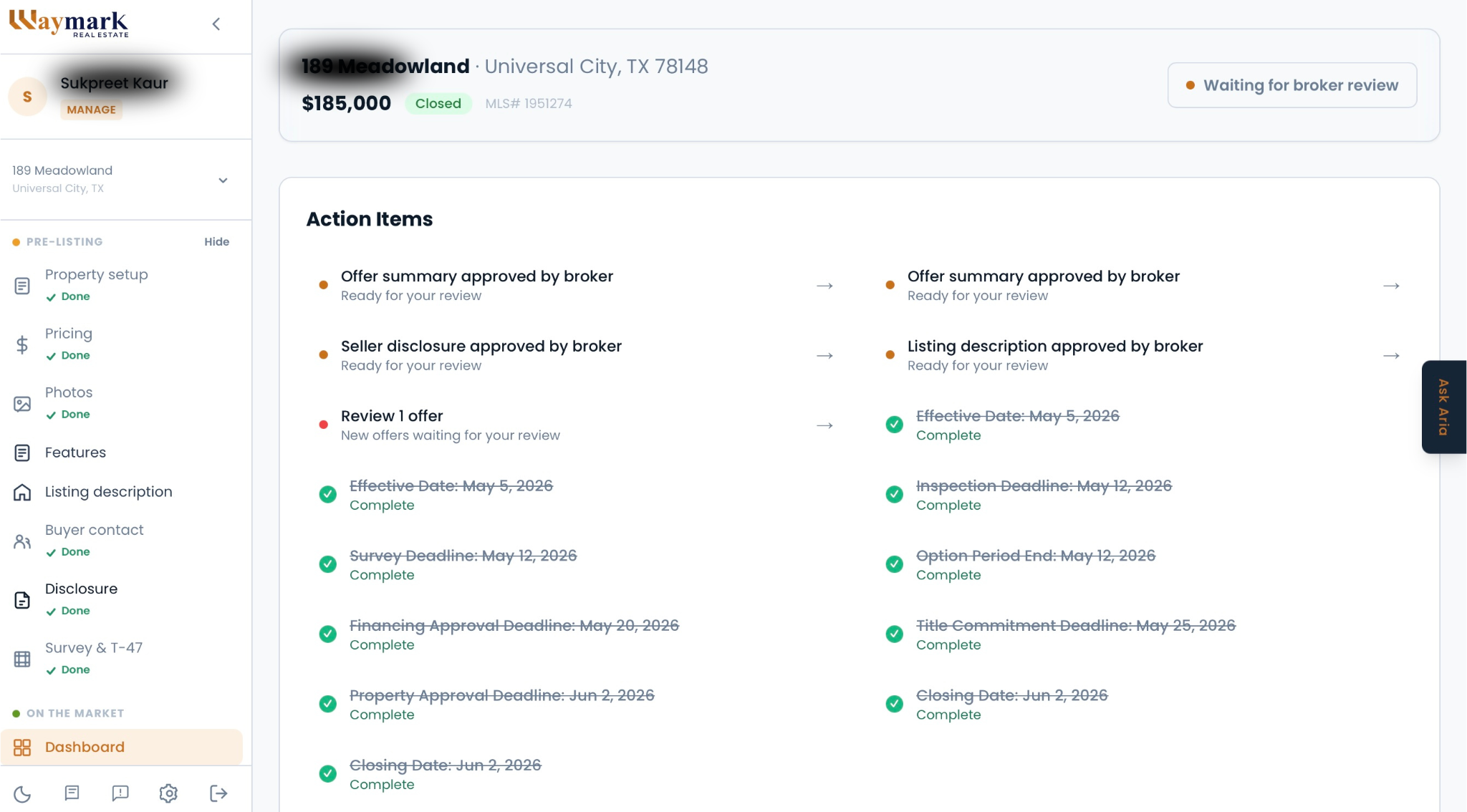
Deadline tracking. The TREC contract has specific deadlines for the option period, financing contingency, survey delivery, title commitment, and closing. Aria tracks every deadline and alerts you before anything is due. Missed deadlines in a Texas transaction can cost you earnest money or give a buyer grounds to terminate.
Closing document review. Before you sign the settlement statement, Aria helps you verify that every line matches what you agreed to in the contract. Prorations, title fees, payoff amounts, credits, and adjustments. Errors found after signing are difficult to reverse.
What the Broker Does That AI Cannot
AI can summarize a contract. It can explain what a contingency means. It can draft a repair response. It can remind you that your option period ends at 5:00 PM local time on the final negotiated day.
AI cannot accept fiduciary responsibility for your transaction. It cannot advise you on whether to hold firm on price based on local market conditions that a licensed professional has observed in the last 30 days. It cannot exercise the professional judgment that Texas real estate law reserves for licensed brokers.
I built the broker consultation model at Waymark around the five moments where that judgment matters most. Before your listing goes live, to review your pricing strategy and disclosure before buyers see it. On every offer, to advise on the terms before you respond. Through the inspection, to help you evaluate repair requests and craft your response. On appraisal gaps, to walk you through your options before you make a decision. And at closing, to review your settlement statement before you sign.
That coverage is not available from a flat fee MLS service. And it does not cost 3% of your sale price.
What Guided Home Selling Looks Like in Practice
A seller in San Antonio lists their home through Waymark. They complete their Texas Seller's Disclosure with Aria's guidance in about 20 minutes. A licensed broker reviews it before it goes to buyers. The home goes live on SABOR and syndicates to Zillow, Realtor.com, Redfin, and Homes.com.
An offer arrives. Aria breaks it down. The buyer is offering $305,000 on a $310,000 list price with a 10-day option period and a $200 option fee. Aria flags that the option fee is below what is typical for this price range in the San Antonio market and calculates the estimated net proceeds after all deductions. The seller decides to counter on the option fee before responding to the price.
The inspection comes back with 38 items. The buyer requests $14,500 in repairs. Aria analyzes the list. Several items are maintenance rather than defects. Three items are material. The seller responds with a $4,200 credit and a repair of one structural item. The deal holds.
The settlement statement arrives the day before closing. Aria reviews it against the contract terms. One proration is calculated incorrectly. The seller flags it to the title company before arriving at the table. It is corrected before anyone signs.
The seller keeps $8,601 more than they would have paid a traditional listing agent. On a $310,000 home in San Antonio, that is real money.
How Waymark Compares to Your Other Options
Texas sellers evaluating their options typically compare three things: what they pay upfront, what they pay at closing, and what support they get in between.
A traditional listing agent charges 2.5% to 3% of the sale price, paid at closing from your proceeds. On a $310,000 home that is $7,750 to $9,300. The support level varies by agent and brokerage.
A flat fee MLS service charges $99 to $499 upfront to submit your listing to the appropriate board. SABOR in San Antonio, HAR in Houston, ACTRIS in Austin, NTREIS in Dallas-Fort Worth. Support after the listing goes live is limited or nonexistent. If you want to understand exactly what flat fee MLS includes and does not include, read our full breakdown: What Is a Flat Fee MLS Service in Texas.
Waymark charges $699 on the Launch plan or $1,199 on the Manage plan, paid flat with no percentage at closing. Both plans include full MLS listing plus AI-powered transaction support through Aria. The Manage plan adds licensed broker consultation at the five critical moments described above.
The comparison is not just about price. It is about what happens when the transaction gets complicated, which most Texas transactions do at some point between listing and closing. For a complete side-by-side breakdown, visit waymarkre.com/compare.
Frequently Asked Questions
Can I sell my house without a listing agent in Texas?
Yes. Texas homeowners can sell without a traditional listing agent. You can list on the MLS through a licensed broker using a flat fee MLS service or a guided platform like Waymark. Your listing appears on SABOR in San Antonio, HAR in Houston, ACTRIS in Austin, or NTREIS in Dallas-Fort Worth, and syndicates to Zillow, Realtor.com, and Redfin. The difference between options is what support you receive after the listing goes live. For a full breakdown see How to Sell a House Without a Realtor in Texas.
What is the difference between a flat fee MLS service and a guided home selling platform?
A flat fee MLS service gets your home listed on the MLS for a low upfront fee, typically $99 to $299, and that is where the support ends. A guided home selling platform like Waymark includes the MLS listing plus AI-powered support for every step that follows: completing the Texas Seller's Disclosure Notice, reviewing offers, understanding TREC contract terms, responding to inspection repair requests, tracking option period and closing deadlines, and reviewing your settlement statement before you sign. A licensed Texas broker is available at every critical decision point.
How does AI help with the Texas Seller's Disclosure Notice?
The Texas Seller's Disclosure Notice is governed by Texas Property Code Section 5.008 and has 13 sections covering property condition, water damage, flooding, utilities, defects, and hazardous conditions. AI walks you through each section in plain English, explains what each question is actually asking rather than the legal phrasing on the form, and flags the items Texas sellers most commonly overlook. A licensed broker reviews the completed disclosure before it is delivered to any buyer.
Why does Waymark include a licensed broker if AI handles the work?
AI can summarize, explain, draft, remind, and analyze. It cannot accept fiduciary responsibility, advise on negotiation strategy based on local market conditions, or exercise the professional judgment that Texas real estate law reserves for licensed brokers. Waymark's model is built around that distinction. AI handles the process. The broker handles the judgment. On the Manage plan, a licensed Texas broker is available before listing, on every offer, through the inspection, on appraisal gaps, and at closing.
How much does it cost to sell a home with Waymark in Texas?
Waymark Launch is $699 flat with no percentage at closing. Waymark Manage is $1,199 flat with no percentage at closing. On a $310,000 home in San Antonio, a traditional 3% listing commission costs $9,300. Waymark sellers keep the difference. Both plans include full MLS listing on SABOR, HAR, ACTRIS, or NTREIS and AI-powered transaction support through Aria.
What changed after the 2024 NAR settlement for Texas home sellers?
The 2024 NAR settlement changed two rules. First, sellers are no longer required to offer a buyer's agent commission as a condition of listing on the MLS. Second, buyers must now sign a written buyer representation agreement before their agent can show them a home, which moved the buyer's agent compensation conversation out of the seller's listing agreement. Texas sellers now have more flexibility in how they structure their transaction costs. Verify current rules for your MLS board at trec.texas.gov.
The Texas Markets Waymark Serves
Waymark operates across four Texas MLS boards. San Antonio through SABOR, where the median home price is approximately $310,000 and a 3% listing commission costs $9,300. Houston through HAR, where the median home price is approximately $295,000 and a 3% listing commission costs $8,850. Austin through ACTRIS, where the median home price is approximately $426,000 and a 3% listing commission costs $12,780. Dallas-Fort Worth through NTREIS, where the median home price is approximately $385,000 and a 3% listing commission costs $11,550.
Every Waymark listing is submitted to the correct board for the seller's market and syndicates to the major consumer portals from there. The AI transaction support and broker availability are consistent across all four markets. To understand how to price your home in any of these markets, read: How to Price Your Home Without a Listing Agent in Texas.
The Book Behind the Platform
I wrote Sell Your Home With AI because I wanted every Texas seller to have the same tools Waymark's platform runs on, whether they use Waymark or not. The book covers pricing, disclosure, offer review, inspection response, appraisal gaps, and closing, with a three-tier AI prompt system for every phase of the transaction and Texas Law Notes in every chapter.
The book is the DIY roadmap. Waymark is the guided platform. Sellers who want to do it themselves have everything they need in the book. Sellers who want AI and a licensed broker handling it for them start a Waymark listing. Either way, the goal is the same: keep your equity.
Ready to sell your Texas home the smarter way? Waymark lists your home on the MLS, guides you through every step with AI, and puts a licensed Texas broker in your corner at every decision that matters. $699 flat. No percentage at close. See plans at waymarkre.com