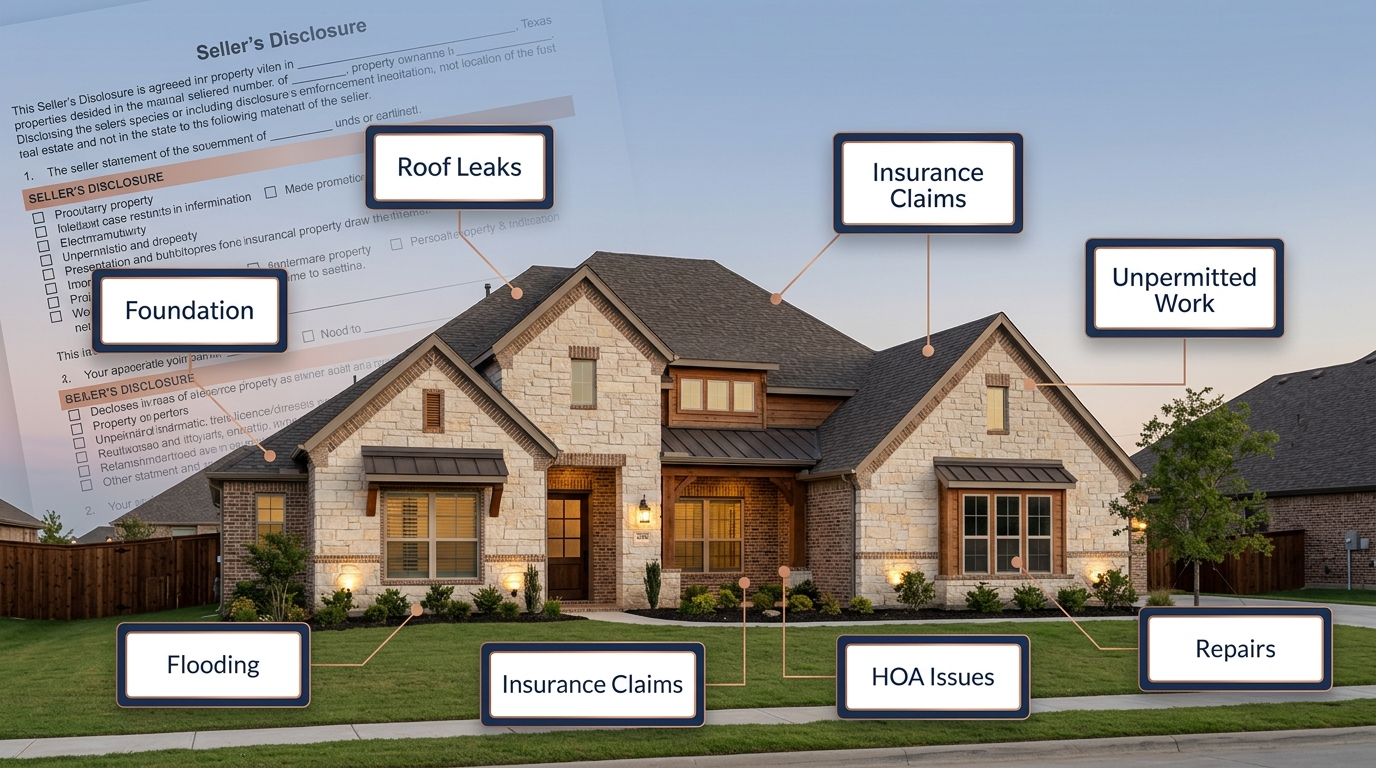
The Texas Seller's Disclosure Notice is the one document in a home sale that most sellers fear and most agents rush through. For FSBO sellers, for sale by owner sellers, flat fee MLS sellers, and anyone selling through a Fixed-Rate Selling platform without a listing agent, completing it correctly is entirely your responsibility. It has 13 sections and over 100 individual items asking what you know about your property's condition and history. Getting it right protects you legally after closing. Getting it wrong creates liability that can follow a transaction for years.
Most sellers complete the disclosure in one of two ways. They answer every question as conservatively as possible, checking No on anything they are not completely certain about, which creates its own risk. Or they answer based on what they can currently see rather than what they know from the history of the property, which is the wrong standard entirely.
The disclosure obligation is about what you know, not about what is currently visible. That distinction matters more than any individual question on the form.
This article covers what the Texas Seller's Disclosure Notice actually requires, what each section is asking in plain English, the items sellers most commonly miss, and how AI helps you complete it accurately before your listing goes live. Chapter 10 of Sell Your Home With AI covers the complete disclosure process in detail including the three-tier AI prompt system for working through every section.
 What the Texas Seller's Disclosure Notice Is and Is Not
The Texas Seller's Disclosure Notice is a standardized form governed by Texas Property Code Section 5.008. TREC publishes the form and updates it periodically. Always verify you are using the current version at trec.texas.gov before you complete it.
The disclosure is not a warranty. Completing it accurately does not guarantee that no problems exist with your property. It is a statement of what you, as the seller, know about the property at the time of sale. A seller who discloses a known defect honestly is in a significantly stronger legal position after closing than a seller who did not disclose it and is later accused of concealing it.
The disclosure is also not optional. Under Texas Property Code Section 5.008, most residential sellers are required to provide it. There are limited exemptions including certain foreclosure sales, estate sales, and transfers between family members, but the vast majority of Texas home sales require a completed disclosure. If you are unsure whether your transaction qualifies for an exemption, consult a licensed Texas real estate professional.
The delivery timing matters. Best practice is to complete the disclosure before your listing goes live and attach it to your MLS listing. Every buyer who requests a showing already has access to it. This approach reduces negotiation friction after an offer is submitted and demonstrates to buyers that you have nothing to hide.
The 13 Sections of the Texas Seller's Disclosure Notice Explained
The Texas Seller's Disclosure Notice has 13 sections. Here is what each one is actually asking in plain English, without the legal phrasing of the form itself.
Section 1: Seller's Disclosure of Property ConditionThis is the main section. It asks whether you are aware of specific defects or conditions affecting the property including the structure, roof, walls, foundation, floors, ceilings, windows, doors, and exterior surfaces. The key word throughout this section is aware. Answer based on what you know from your time owning the property, from previous inspection reports, and from any repairs or remediation that was performed.
Section 2: Seller's Disclosure of Hazardous or Toxic SubstancesThis section asks about asbestos, lead-based paint, urea formaldehyde insulation, radon gas, previous use of the property to manufacture methamphetamine, and other hazardous materials. If your home was built before 1978, federal law requires a separate lead paint disclosure in addition to this section.
Section 3: Seller's Disclosure Regarding Range, Location, and Type of Fault LinesThis section asks whether the property is located in a known fault area. For most Texas properties this is not applicable but it is required by the form regardless.
Section 4: Seller's Disclosure Regarding the Property's Location in a Flood PlainThis section asks whether any part of the property is located in a FEMA Special Flood Hazard Area. Check the FEMA Flood Map Service Center at msc.fema.gov if you are unsure. This is one of the items buyers and their lenders pay close attention to.
Section 5: Seller's Disclosure of Whether Property is in a Certificated Service AreaThis section asks about the utilities serving the property: water, sewer, electric, gas, and trash. It asks whether service is provided by a public utility, a private provider, a well, a septic system, or no service at all. Answer specifically for each utility type.
Section 6: Seller's Disclosure of Water SourceIf the property uses a private well, this section asks about water quality testing and any known issues with the water supply. If the property uses municipal water, note that and move on.
Section 7: Seller's Disclosure Regarding Structural or Mechanical ConditionsThis is the section sellers most commonly answer incompletely. It asks about the HVAC system, water heater, plumbing, electrical system, irrigation system, pool or spa equipment, and other mechanical systems. Answer based on what you know about each system including age, service history, and any known issues. An HVAC that has never been serviced during your ownership is worth noting even if it currently runs.
Section 8: Seller's Disclosure Regarding Present or Previous Damage to the PropertyThis section asks about fire damage, flood damage, water penetration, previous repairs made to address water intrusion, and any other damage the property has sustained. This is the section where prior water intrusion most commonly goes undisclosed. If water came in through a window, door, roof, or foundation during your ownership and you had it repaired, that repair needs to be disclosed here even if the property is currently dry and shows no evidence of the prior problem.
Section 9: Seller's Disclosure Regarding Common AreasIf the property is part of a homeowner association or has shared common areas, this section asks about the HOA, the monthly or annual assessment amount, any pending special assessments, and any active litigation involving the HOA. Contact your HOA management company before completing this section to confirm current assessment amounts and any pending items.
Section 10: Seller's Disclosure Regarding Any Notices of ViolationThis section asks whether you have received any notices from any governmental authority about code violations, permit issues, or required repairs. If you received a notice and corrected the issue, disclose both the notice and the corrective action.
Section 11: Seller's Disclosure Regarding Room Additions, Structural Modifications, and RepairsAny addition, modification, or structural repair made during your ownership needs to be disclosed here including whether it was done with a permit and whether the permit was properly closed. Unpermitted work is one of the most common issues that surfaces during the inspection and creates negotiation problems after the fact. Disclose what you know.
Section 12: Seller's Disclosure Regarding Settling, Flooding, Drainage, or GradingThis section asks about foundation movement, settling, soil movement, and any drainage or grading issues on the property. If any inspector or contractor has ever noted foundation movement during your ownership, disclose it here. Note the disclosure obligation is not limited to structural failures. Movement observed and noted by a previous inspector is a known condition that requires disclosure.
Section 13: Seller's Disclosure Regarding Other Conditions or DefectsThis is the catch-all section. It asks whether there are any other material defects or conditions affecting the property that have not been disclosed elsewhere. If you know something material about the property that does not fit neatly into one of the preceding sections, this is where it goes. When in doubt, disclose.
The Items Sellers Most Commonly Miss
In 15 years of Texas real estate, these are the items that appear most often in post-closing disputes. They come up whether the seller used a traditional listing agent, a flat fee MLS service, or sold FSBO and for sale by owner. The disclosure obligation is the same regardless of how you listed.
Prior water intrusion that was repaired. Sellers who had a roof leak five years ago, had it repaired, and see no current evidence of the problem frequently answer No to the water damage question. The correct answer is Yes with an explanation of when it occurred and what was done to repair it.
Foundation movement noted by a previous inspector. If a home inspector during your original purchase noted foundation movement and recommended monitoring, that is a known condition. It does not matter whether the movement has progressed. It does not matter whether a subsequent engineer said it was within tolerance. The fact that movement was noted and you are aware of it requires disclosure.
Mold remediation. Any known mold condition must be disclosed. If mold remediation was performed on 25 or more contiguous square feet, Texas law requires a certificate of mold remediation. That certificate must be provided to the buyer. Sellers who had remediation performed without obtaining the certificate should address that before listing.
Unpermitted additions or improvements. A garage conversion, a room addition, a covered patio, a pool house. If it was built during your ownership without a permit or the permit was never properly closed, disclose it in Section 11.
HOA pending special assessments. The monthly assessment amount is easy to find. Pending special assessments for roof replacement, parking lot repair, or capital improvements require a call to the HOA management company. Do not guess at this number.
Previous pest infestation and treatment. If the property was treated for termites or other wood-destroying insects during your ownership, disclose it. Note the date of treatment and whether a transferable warranty is available.
The Death Disclosure Rule in Texas
This is one of the most misunderstood disclosure requirements in Texas real estate, and the most commonly misstated one.
Under Texas Property Code Section 5.008(c), sellers have no duty to disclose deaths from natural causes, suicide, or accidents unrelated to the property's condition. There is no three-year window. The protection applies regardless of when the death occurred or how long ago it was.
Homicide is not specifically addressed by the Texas Property Code. Professional consensus among Texas real estate practitioners is to disclose a homicide that occurred in the property. If you have questions about a specific situation, consult a licensed Texas real estate attorney before completing the disclosure.
HIV status of previous occupants is explicitly protected under Texas law. No disclosure is required.
How AI Helps FSBO and For Sale By Owner Sellers Complete the Disclosure
For FSBO sellers, for sale by owner sellers, and Texas homeowners using a flat fee MLS or Fixed-Rate Selling platform, completing the Texas Seller's Disclosure Notice accurately requires two things: understanding what each question is actually asking and knowing your property's history well enough to answer honestly. AI helps with the first part directly and helps you organize the second.
A well-constructed AI prompt can walk you through every section of the disclosure in plain English, flag questions where your property history suggests a Yes answer is warranted, and identify items you may have overlooked. The prompt system in Chapter 10 of Sell Your Home With AI is built specifically for this process. You provide your property history and the AI works through the form section by section, asking follow-up questions that surface the items most commonly missed.
What AI cannot do is make legal decisions for you. If you are uncertain whether a condition requires disclosure, that uncertainty is itself a signal worth taking seriously. When in doubt, disclose. A disclosed defect that a buyer accepts is a closed issue. An undisclosed defect that surfaces after closing is a legal problem.
Waymark's Aria handles the complete disclosure process from one platform. Section-by-section guidance in plain English. Field completion. E-signature. Delivery to buyers. No printing, scanning, or email threads required. On the Waymark Manage plan, a licensed Texas broker reviews your disclosure before it goes to buyers at the moment that matters most. The complete three-tier AI prompt system for the disclosure is in Sell Your Home With AI, available on Amazon.
When to Deliver the Disclosure: What Texas Sellers Must Know
Completing the disclosure is only half the requirement. Delivering it correctly and on time is the other half.
In Texas, the seller must deliver the completed Seller's Disclosure Notice to the buyer before the buyer submits an offer, or as specified in the purchase contract. This requirement is the same whether the property is listed through a traditional agent, a flat fee MLS service, or a Fixed-Rate Selling platform like Waymark. The TREC One to Four Family Residential Contract includes a deadline for disclosure delivery. If the seller fails to deliver the disclosure by that deadline, the buyer may have the right to terminate the contract and recover their earnest money.
The safest approach is to complete the disclosure before your listing goes live and attach it directly to your MLS listing. Buyers can review it before they submit an offer. This eliminates the delivery deadline pressure entirely and signals transparency to every buyer who looks at your home.
Always verify current disclosure delivery requirements at trec.texas.gov. TREC updates forms and requirements periodically and the requirements in effect at the time of your transaction govern your obligations.
Selling your Texas home FSBO, for sale by owner, or through Fixed-Rate Selling?
Waymark's Aria walks you through every section of the Texas Seller's Disclosure Notice in plain English, handles e-signature, and delivers the completed disclosure to buyers. All from one platform. $699 flat. No percentage at close.
See how Waymark works at waymarkre.com